Vultr is an Unmanaged Cloud hosting service. However, deploying a server and installing WordPress is easy and straightforward. It’s a matter of minutes to get your server WordPress ready on Vultr.
In this tutorial you will go through:
- What is Vultr?
- Why Choose Vultr?
- A step-by-step guide to installing WordPress on Vultr.
- Point your domain name to the server.
- Install a free SSL certificate.
If you have an existing WordPress site and want to migrate it to Vultr, read this guide.
What is Vultr?
Vultr is a global cloud hosting service that provides reliable and high-performance hosting solutions.

With 33 data center regions around the world (as of October 2026), it has one of the largest networks among cloud VPS providers, enabling you to easily deploy cloud infrastructure solutions no matter where your customers are.
Vultr pricing starts at as little as $2.50 per month. For this amount, you get a small cloud VPS (512 MB RAM), but it’s IPv6-only and offered in just two locations. For this tutorial, plan on the $5 or $6 plans instead.
Why Choose Vultr?
- Vultr is a cloud hosting service: Which means better performance and uptime, and less cost.
- Low pricing: Since it’s a cloud hosting service, the running and maintaining costs will be reduced. Thus the server cost will be reduced.
- Pay as you go: You will not pay upfront, you will be charged at the end of your month for the resources you consumed. If you created a server for 7 days and deleted it, you will be charged for the 7 days only.
- 33 data center regions: You can deploy your servers and apps in lots of server locations around the world.
- Easy to set up and use: Especially if you are a beginner, Vultr is easy to navigate through and create instances and apps.
- Modern hardware: Vultr’s High Performance plans run on newer-generation AMD EPYC and Intel Xeon CPUs with NVMe storage.
Step 1: Sign up for Vultr
Go to Vultr.com. Use this link to get free credit to test their service. The credit shows up once you sign up and add a valid payment method. It doesn’t last forever, so check the expiry date on your billing page.
When you land on the Vultr home page, add your email and a new password, tick the box to accept the terms, and click Create free account.

When you click on Sign up, you will have the option to sign up via your email, or via Google or GitHub.
Choose the one you like and proceed to the next billing page where you should add a payment method.
There are five payment methods Vultr supports, they are Credit Card, Paypal, Crypto, Alipay, and Wire Transfer. You can also see the free credits appear on the right side after you use our link provided above.
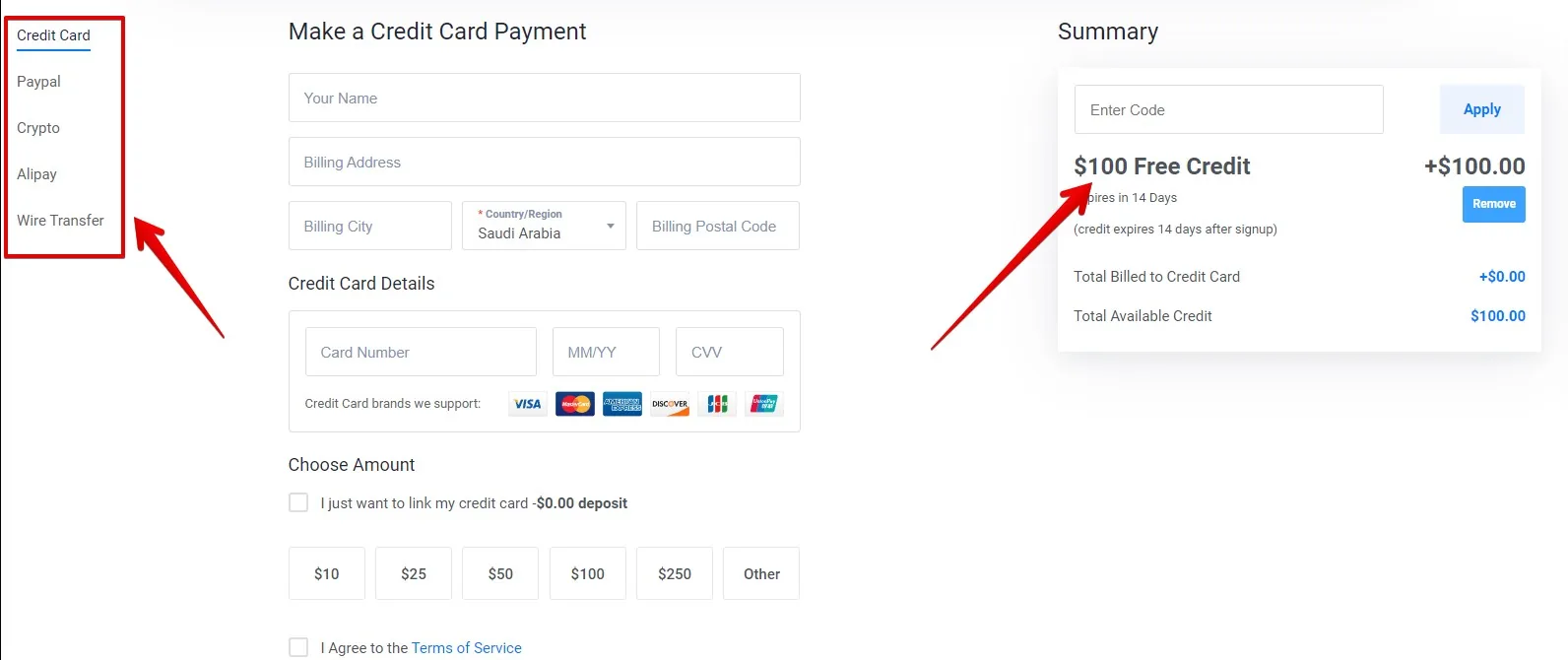
To check that your payment method works, Vultr may ask you to add some funds first. That money isn’t lost: it sits in your account as balance for later use.
After you verify your payment, your billing page shows the free credit along with any funds you added.
Once you choose the suitable payment method and agree to the Terms of Service, proceed to checkout.
Lastly, verify your email address if you used your own email to sign up for Vultr. Go to your email inbox, open the Vultr verification email, and then click Verify Your E-mail.
Now that you are a Vultr customer, let’s move on to step two of how to create and install a WordPress website on Vultr cloud compute.
Step 2: Deploy an Instance and Choose WordPress
In this step, we will create a server (instance) and install WordPress on top of it.
1. Go to Compute:
To create an instance on Vultr, go to Products > Compute and click Deploy.
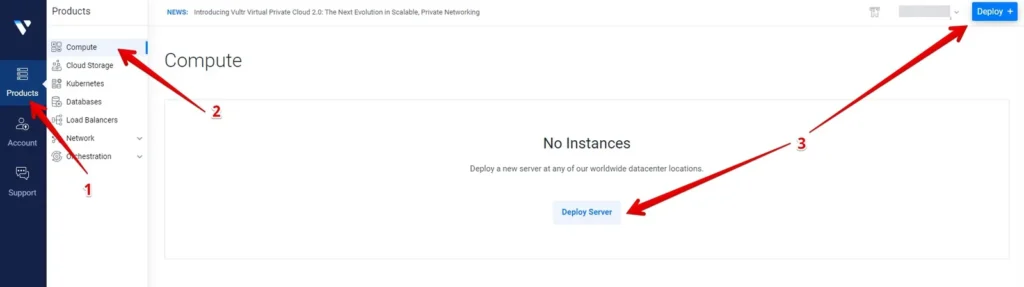
Here are the steps for deploying a new server and installing WordPress on the Vultr instance. Vultr has redesigned its deploy page since we took these screenshots: the current console asks for the server type first, then the location, then the plan, and only after you click Configure Software do you pick the image (WordPress). The choices themselves are the same as below.
2. Choose the server type:
Vultr offers 4 types of servers you can choose from. In the current console, the first two show up as Dedicated CPU and Shared CPU. They are:
- Optimized Cloud Compute (Dedicated CPU): For more demanding apps such as production websites, CI/CD, and video transcoding.
- Cloud Compute (Shared CPU): Cloud VPS servers that share the same physical host, each with its own RAM, vCPU, bandwidth, and storage allowance.
- Cloud GPU: For apps demanding more such as AI, machine learning, and data analytics.
- Bare Metal: A physical dedicated server, a non-virtualized machine.
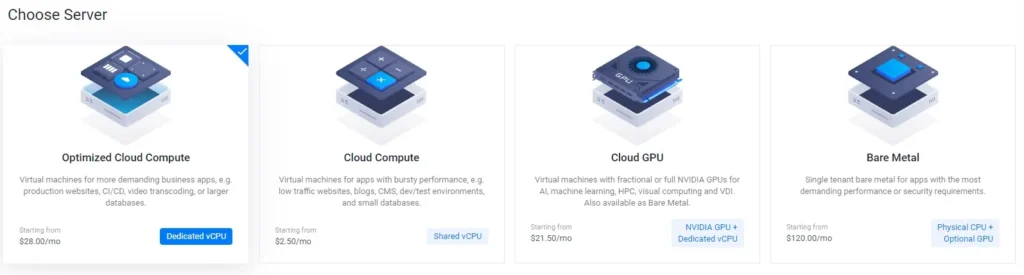
Essentially, what we are aiming for is a cloud VPS server, a shared environment with dedicated resources, so I will go with the Cloud Compute (Shared CPU) option.
3- Choose the CPU & storage technology:
When you choose the Cloud Compute option, you will be shown four types of cloud VPS servers (the current console lists them as Cloud Compute, High Frequency, and High Performance with AMD or Intel plans):
- AMD High Performance: Powered by the latest generation AMD EPYC CPUs and NVMe SSD.
- Intel High Performance: Powered by the new generations of Intel Xeon CPUs and NVMe SSD.
- High Frequency: Powered by the 3GHz+ Intel Xeon CPUs and NVMe SSD.
- Regular Performance: Powered by the previous generation Intel CPUs and regular SSD.

All types can do pretty well for websites with normal needs. However, in our earlier tests, High Frequency performed the best. AMD High Performance is in the next place.
4- Choose the server location:
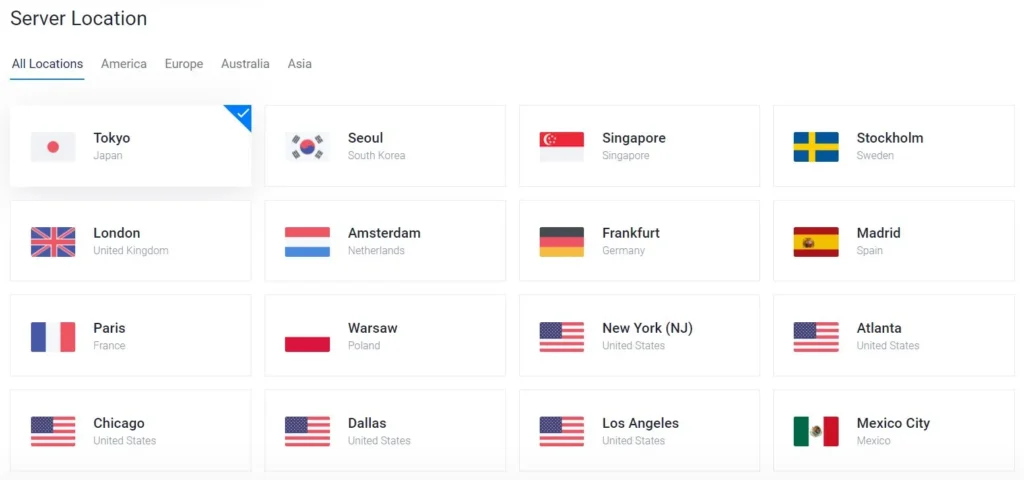
From the 33 data center regions Vultr has around the world, choose the closest location to your potential customers.
The closer your website is stored, the faster your server can receive and fetch data and content to your website visitors.
5- Select WordPress:
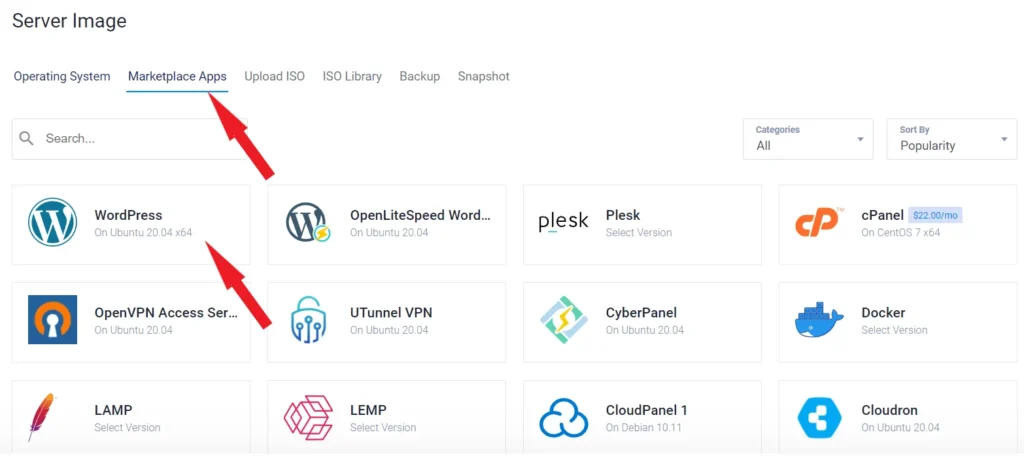
Click Configure Software (older versions of the page called this section Server Image), go to Marketplace Apps, and search for WordPress using the search box. Select the WordPress app and head down to the next step.
6- Choose the server size:
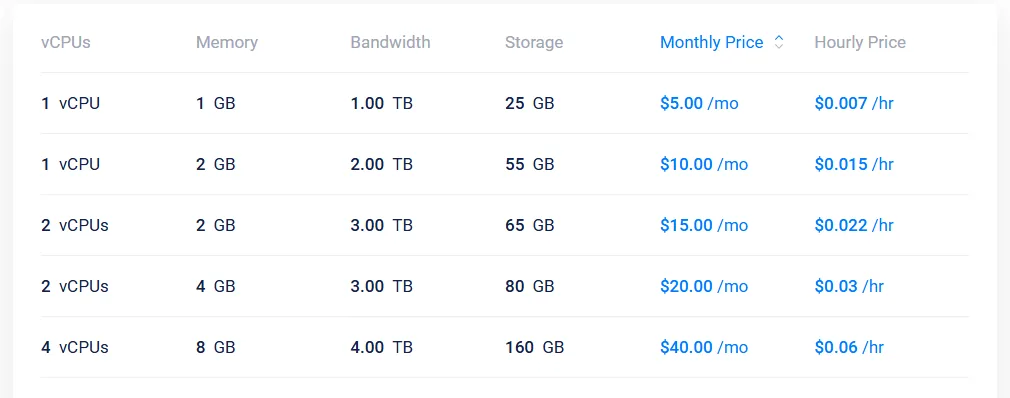
The server size is the resources you want your server to acquire. Choose the one that suits your website needs.
If you don’t have an idea of what server size you need to choose, or your website is below 10K visits/month, choose the $5 (regular Cloud Compute) or $6/month (High Frequency or High Performance) plan. Each has 1 vCPU and 1 GB of RAM. You can always scale up later.
7- Enable auto backups:
This feature is essential, as it ensures your website’s safety. You will be able to revert to an older backup if anything wrong happens, like cyber attacks, malware, or wrong configuration.
This will add an extra 20% of the server cost (Vultr keeps your two most recent backups).
8- Add server hostname & label:
This is to categorize servers on your Vultr dashboard. Enter a name and a label for your server to recognize it later among other servers on your account.
At the end of the page, you will be shown a Summary of your server cost. Check everything is set up and click Deploy (older versions of the page said Deploy Now).
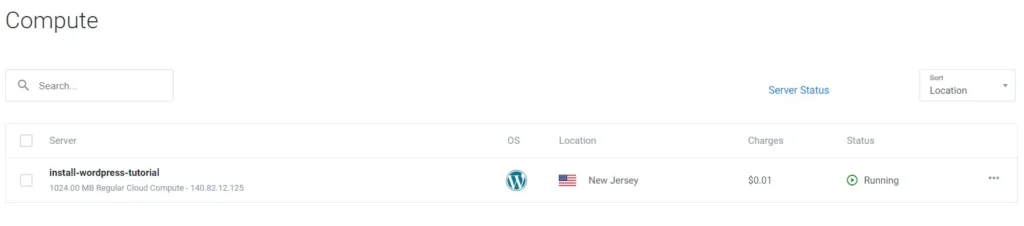
Wait a few minutes to let Vultr configure the server for you. Once this is done, you will see the status of the server updated to Running.
You will find the servers you’ve created in the Instances tab, just like the one I created in this tutorial.
Step 3: Complete the WordPress Installation
To complete your WordPress installation, you need to log in to your WordPress admin panel.
1. Access your WordPress site:
To log in to your WordPress admin dashboard enter (http://your server IP address/wp-admin/) in your browser just like this one: (http://207.148.88.173/wp-admin/). You can copy your server IP address from the server overview.
Or click the link that Vultr provides in the server overview under WordPress server details.
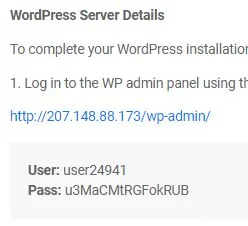
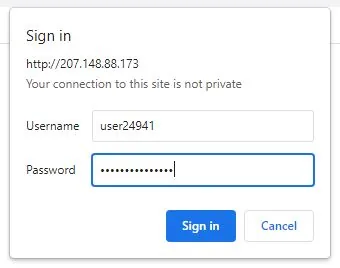
Once you do that, it will redirect you to your WordPress installation where you have to enter the username and password.
Copy the username and password that Vultr randomly created beneath the WordPress Server Details and paste it into the empty fields
Next, Choose a language.
Next, enter the details for your new WordPress website: site title, username, password, and email. Fill in your information and click Install WordPress.
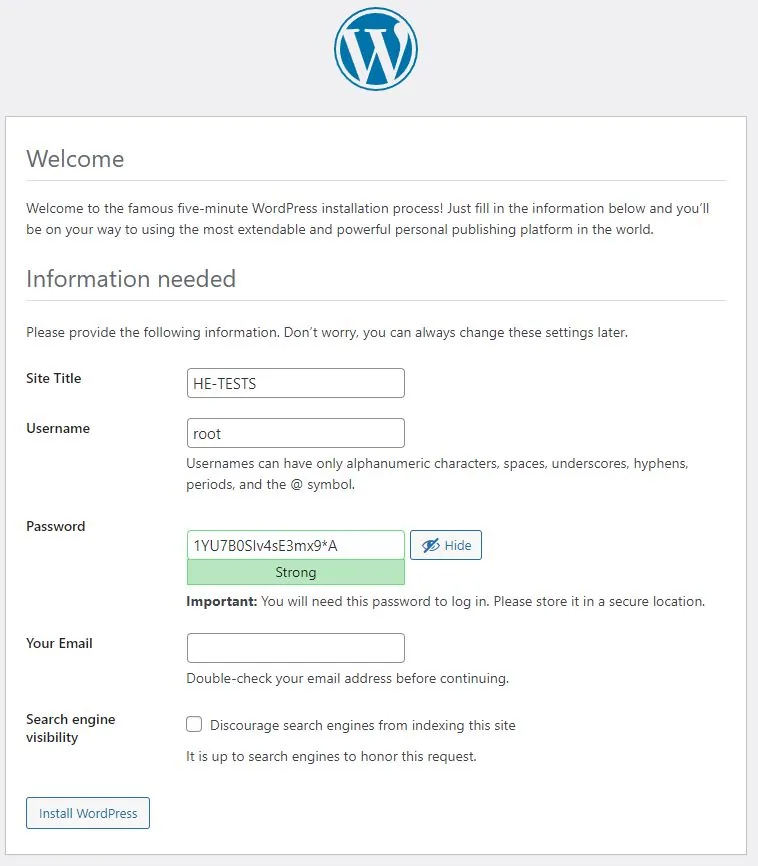
To access your WordPress admin panel click login and enter the username and password that you just created then click Log in.
2. Associate your domain with WordPress:
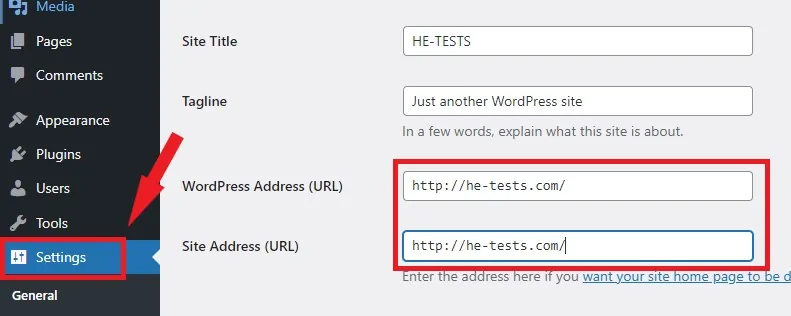
From your WordPress Admin main panel go to Settings > General.
Instead of your server IP address, enter your domain name in both “WordPress Address (URL)” and “Site Address (URL)” in your WordPress dashboard.
Next, scroll down to the bottom and click Save Changes.
Step 4: Point Your Domain Name to Vultr
Now you need to point your domain name to your WordPress website so that whenever someone types in your domain name, he will be redirected to your website.
To do that, you need to add or edit the “A” record to map the domain name to the IP address of your server.
Go to where your domain name is hosted, open its DNS settings or the advanced settings or whatever your domain name registrar names it.
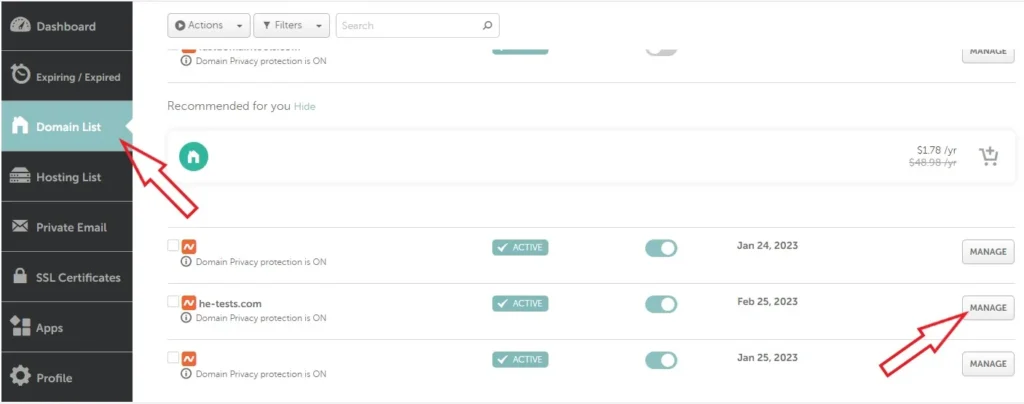
Click add a record, and select the A record.
- In the Host field, add the “@” sign. This represents the origin domain.
- Copy the IP address of your server and paste it into the value field.

If an A record for “@” already exists, edit its value instead of adding a second one, otherwise some visitors may still land on the old server. Save the changes and you are done.
Step 5: Install Let’s Encrypt Free SSL Certificate
Your website by now should run perfectly, but it’s not secured by an SSL yet.
Before we go on with the SSL Certificate installation, verify that the DNS of your domain has finished propagation, and the domain name is visible throughout the internet.
Another way to check is by typing in the domain name in your browser. If it takes you to your website, then it’s propagated successfully. If not, wait for a couple of minutes.
To install the Let’s Encrypt free SSL certificate, open your server overview and click on the View Console icon to access the server. Or use a third-party SSH client like PuTTY.
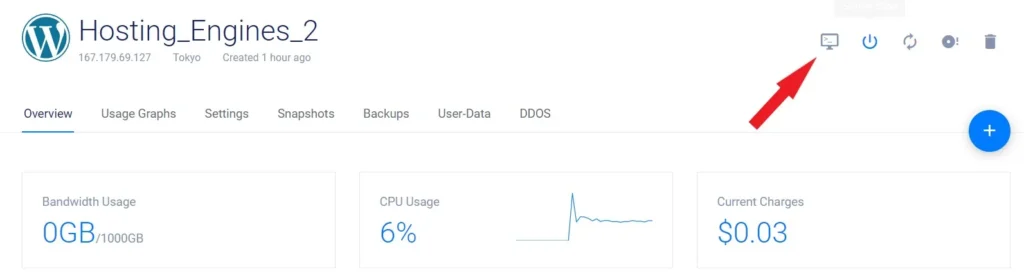
Use the root login (username and password) from the Server Information screen.
After you log in to your server root, copy this line below and paste it into the SSH terminal, and hit enter.
sudo certbot --nginxNext, Certbot will ask for your email address. Enter it and press Enter. Note that Let’s Encrypt stopped sending expiry reminder emails in June 2025, so you won’t get warnings that way. That’s fine, because Certbot normally sets up automatic renewal, so the certificate renews itself before it expires.
Next, agree to the terms of service, type in “Y” for yes, and press enter.
The following step asks if you are willing to share your email address, enter “Y” for yes and “N” for no, and then press enter.
At last, type your domain name and hit Enter. You should see a message that tells you that an SSL certificate has been successfully deployed.
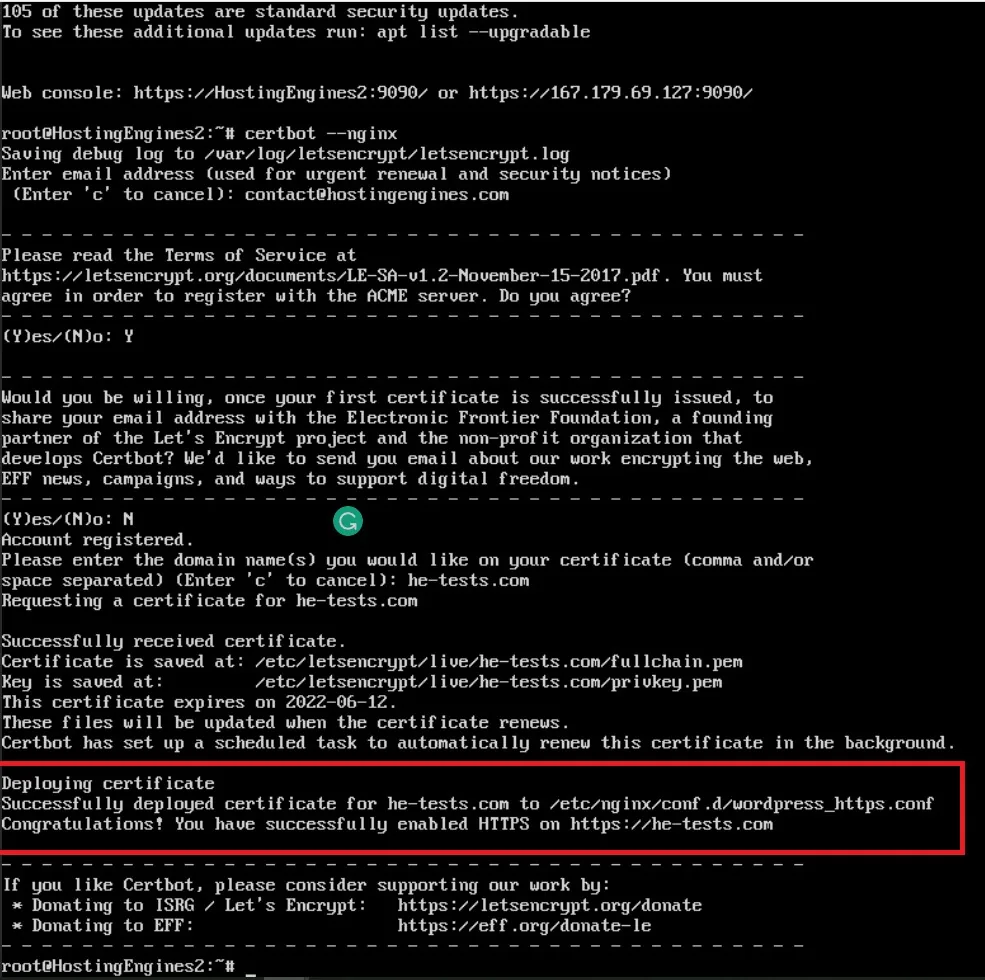
By now you should have a WordPress website installed on Vultr Cloud Compute and it’s secured with an SSL certificate.
Read how to migrate your WordPress site to Vultr.
Final Words
Vultr is one of the best cloud hosting services on the entire internet. It offers reliable hosting products with high performance at a low price.
Installing WordPress on a Vultr server is now an easy task. In fact, Vultr made it simple enough even for beginners.
Following these steps will lead you to create your own WordPress website on Vultr without any developer help.
Read also:
Start a WordPress Blog
Install WordPress On DigitalOcean
Install WordPress on Linode
Create and Install a WordPress Website On Cloudways
Create a WordPress Website on DreamHost
How to Host and Install PHP Script on Vultr