
This free redirect checker follows a URL hop by hop and shows every 301, 302, 307 or 308 redirect, the status code at each step and where it finally lands. Paste a link and click Trace redirects. No sign-up needed.
How to use the redirect checker
- Paste the URL you want to test. Include
http://if you want to see the HTTP to HTTPS step. If you leave the scheme out, the tool starts fromhttps://. - Pick who the request comes from: Desktop browser, Mobile (iPhone) or Googlebot. Some sites redirect phones or bots differently, so this is worth switching when something looks off.
- Tick Also check all 4 versions if you want to test the http, https, www and non-www versions of the domain in one go.
- Click Trace redirects and read the results.
How to read the results
The top card sums it up: No redirects, a count like 2 redirects to the final page, or Redirect loop detected. Under it you’ll see the final URL, its status code and the total time the whole trip took in milliseconds.
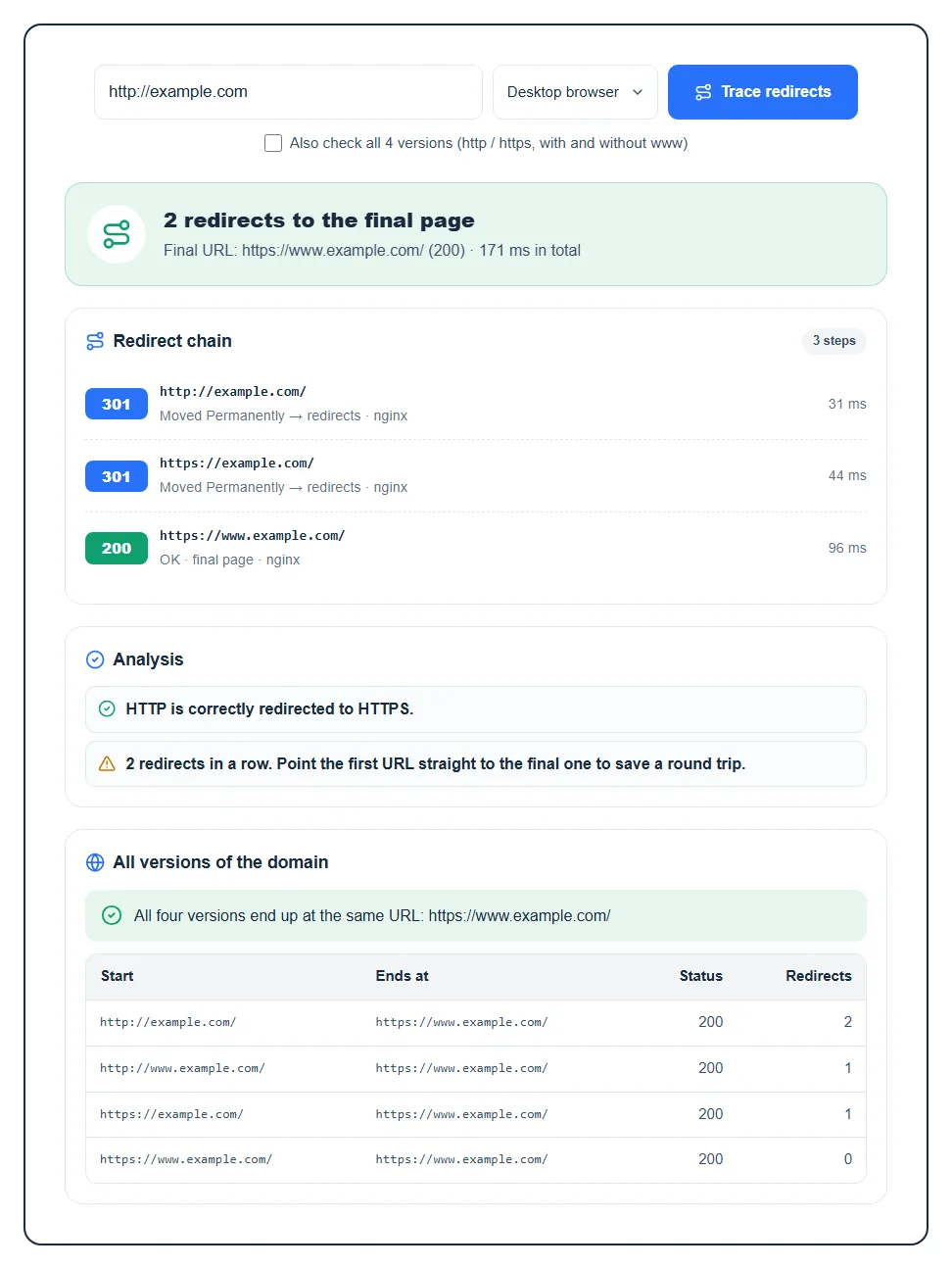
Redirect chain
Every step gets its own row: the status code badge, the exact URL, the status text (like “Moved Permanently”), the server software if the site reveals it, and how many milliseconds that hop took. The last row is the page people actually end up on.
Analysis
This is where the tool gives you advice. It flags redirect loops, chains with more than 2 redirects, temporary redirects (302, 303, 307) that probably should be permanent, and a final page that returns an error. It also confirms good news, like “HTTP is correctly redirected to HTTPS” or “Clean redirect chain”.
All versions of the domain
With the checkbox on, you get a table with four rows (Start, Ends at, Status, Redirects), one for each version of the homepage. Ideally all four end at the same URL. If they don’t, search engines may see two copies of your site.
Redirect status codes explained
| Code | Meaning | When to use it |
|---|---|---|
| 301 | Moved permanently | The page or site moved for good. The usual choice for SEO. |
| 308 | Permanent redirect | Like 301, but the request method (for example a form POST) is kept. |
| 302 | Found (temporary) | Short-term moves, like a sale page or maintenance. |
| 307 | Temporary redirect | Like 302, but the method is kept. Also used by browsers for HSTS. |
| 200 | OK | The final page loaded. This is what you want at the end of the chain. |
| 404 / 410 | Not found / gone | The redirect points at a page that doesn’t exist. Fix the target. |
Common redirect problems and fixes
Redirect chains
A typical chain looks like http://example.com to https://example.com to https://www.example.com to https://www.example.com/home/. Each hop costs time and crawl budget. Point the first URL straight at the final one, and update your internal links so they skip redirects completely.
Redirect loops
A loop sends the visitor back to a URL it already visited, so the page never loads and browsers show “too many redirects”. It often happens when a plugin forces HTTPS while the server or CDN forces HTTP, or when two rules fight over www. Turn off one rule at a time until the loop stops.
Temporary instead of permanent
Many plugins and hosts create 302 redirects by default. If the move is permanent, change it to a 301 so search engines treat the new URL as the real one.
HTTPS not forced
If http:// loads with a 200 and no redirect, visitors can browse your site unencrypted. Add a 301 to HTTPS, and confirm your certificate is fine with our SSL checker.
When a redirect check helps
- After moving your site to a new domain or a new host.
- After switching to HTTPS or changing your www setting.
- Before you share or buy a link, to see where it really goes. Short links and affiliate links often hide several hops.
- When Google Search Console reports a “Page with redirect” or “Redirect error”.
Once the redirects are clean, check the final page’s title and description with our meta tags analyzer, or see how heavy it is with the page size checker.
FAQ
How do I check where a URL redirects?
Paste it into the redirect checker above and click Trace redirects. You’ll see every hop and the final destination without having to open the link yourself.
How many redirects are too many?
More than one or two is already worth fixing. Each extra hop slows the page and search engines follow only a limited number. This tool follows up to 10 redirects and warns you as soon as a chain has more than 2.
Is a 301 or 302 redirect better for SEO?
Use a 301 when the move is permanent. A 302 tells search engines the old URL is coming back, so they may keep it in their index instead of the new one.
Can it detect JavaScript or meta refresh redirects?
No. It reads the server’s real HTTP responses and follows the Location header, which covers 301, 302, 303, 307 and 308. Redirects done by JavaScript or a meta refresh tag inside the page won’t show up.
Can I check several URLs at once?
The tool traces one URL per check. The “all 4 versions” option is the exception: it tests the http, https, www and non-www homepages of your domain together. Each visitor gets about 20 checks every 10 minutes, or 8 when the 4-version option is on.
Is this redirect checker free?
Yes, it’s completely free and you don’t need an account.