
This free SSL checker connects to any website over HTTPS and tells you if browsers trust its certificate, when it expires, who issued it and which domains it covers. Type a domain below and click Check SSL. No sign-up needed.
How to check an SSL certificate
- Type the domain you want to test, like
example.comorshop.example.com. You can paste a full URL too. The tool keeps only the host name and drops the path. - Click Check SSL. The tool looks up the domain’s IP address and opens a real TLS connection on port 443, the same way a browser would.
- Read the summary at the top, then the checklist and certificate details below it.
Testing a subdomain? Check it on its own. A certificate for example.com doesn’t automatically cover blog.example.com, and that’s one of the most common reasons people see a warning.
How to read the results
The top card gives you the verdict in plain words. You’ll see one of three results:
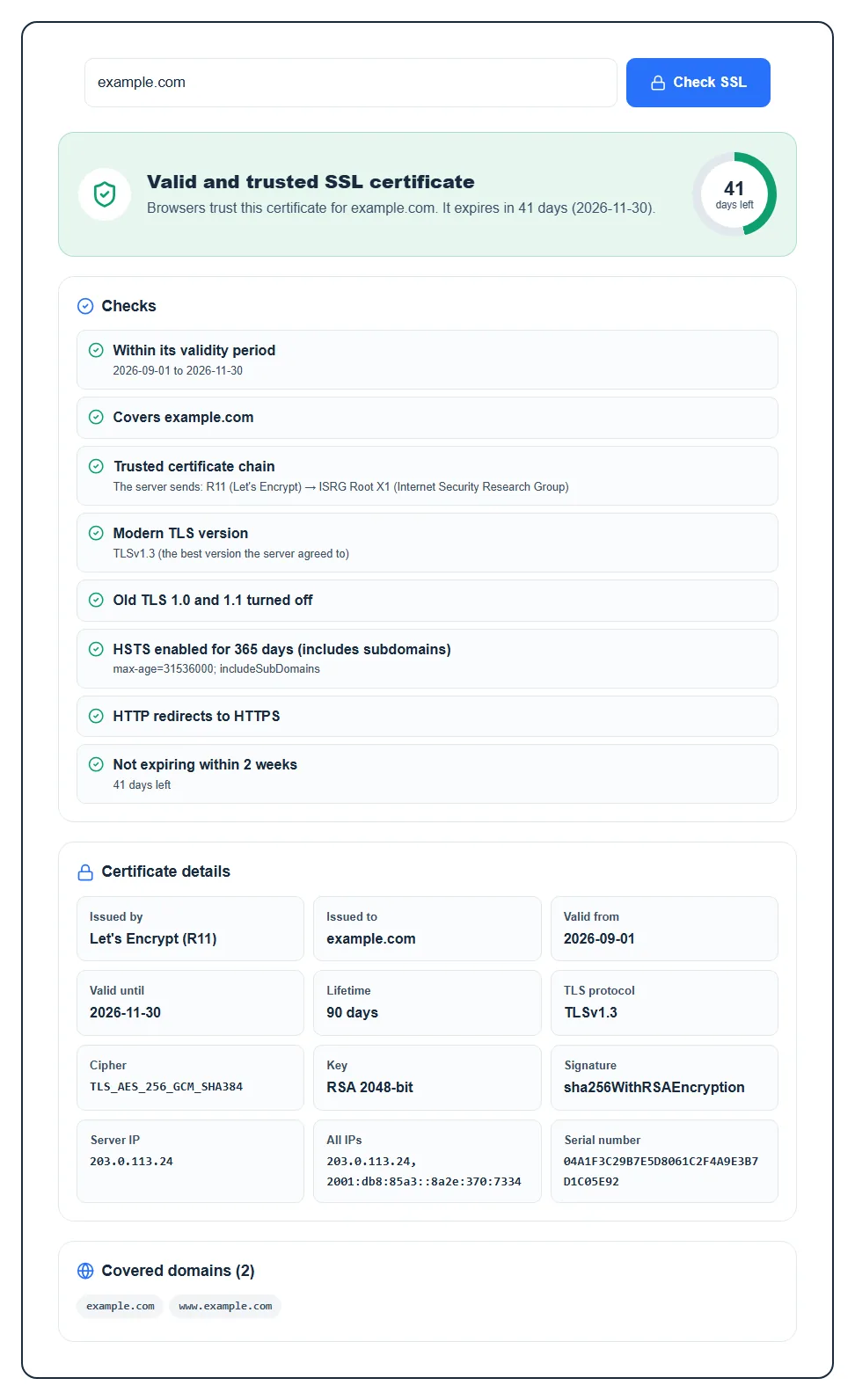
- Valid and trusted SSL certificate: browsers accept it, and the ring shows how many days are left.
- Valid, but expiring soon: it works today but expires within 14 days. Renew it now.
- SSL certificate problem: visitors will get a warning. The card tells you exactly why.
The checks
- Within its validity period: today falls between the start and end dates of the certificate.
- Covers your domain: the name you typed is listed in the certificate, either exactly or through a wildcard like
*.example.com. - Trusted certificate chain: the certificate links back to a trusted root authority. The chain the server sent is listed next to it. A yellow mark here means the chain couldn’t be judged because another check already failed.
- Modern TLS version: the connection used TLS 1.2 or TLS 1.3. Anything older is flagged.
- Not expiring within 2 weeks: a simple early warning so a renewal never sneaks up on you.
Certificate details
Below the checks you get the raw facts: Issued by (the certificate authority, such as Let’s Encrypt or Sectigo), Issued to, Valid from and Valid until, the total Lifetime in days, the TLS protocol and Cipher that were negotiated, the Key type and size (RSA or ECDSA), the Signature algorithm, the Server IP the tool connected to, and the Serial number. The Covered domains section lists every host name the certificate is valid for.
Common SSL errors and how to fix them
“The certificate has expired”
Renew it with your host or certificate authority. If you use a free Let’s Encrypt certificate, auto-renewal has probably stopped working, often because the domain’s DNS changed or a renewal job failed. If you manage your own server, our guide to installing a free Let’s Encrypt certificate on Vultr walks through the setup.
“The certificate does not cover this domain”
The server is showing a certificate made for a different name. Look at the Covered domains list. Often the www version or a subdomain is missing, or the site is on shared hosting and the server is handing out the host’s default certificate. Reissue the certificate with every name you need.
“The certificate chain is not trusted”
Two usual causes. Either the certificate is self-signed, which browsers never trust on a public site, or the server isn’t sending the intermediate certificate. The second one is sneaky: your desktop browser may load the site fine because it cached the intermediate, while phones and apps fail. The fix is to install the full chain (on Nginx that’s usually the fullchain.pem file) and restart the web server.
“Could not connect to the site over HTTPS”
Nothing answered on port 443. The site may not have SSL set up at all, a firewall may be blocking the port, or the domain points to the wrong server. Check where it points with our DNS lookup tool.
When to use an SSL checker
- Right after you install or renew a certificate, to confirm the server picked it up.
- After moving to a new host or changing DNS, since the new server needs its own certificate.
- When a visitor reports a “Not secure” or “Your connection is not private” message.
- Every few weeks as a habit. Certificate lifetimes keep getting shorter, so silent renewal failures matter more than they used to.
New to all this? Start with what an SSL certificate is and how it works.
FAQ
How do I know if my SSL certificate is valid?
Run your domain through the checker above and look for “Valid and trusted SSL certificate”. That means the dates are fine, the name matches and the chain is trusted, which are the same things a browser checks before it shows the padlock.
How can I check when an SSL certificate expires?
Enter the domain and read the “days left” ring or the Valid until date. You can also click the padlock (or site info icon) in your browser and open the certificate viewer, but the checker gives you the same date in one step.
Can I check another website’s SSL certificate?
Yes, you can check any public website. Certificates are public by design because every visitor’s browser receives one. Private network addresses can’t be checked.
Why does my site work on my computer but show an error on phones?
Usually a missing intermediate certificate. Desktop browsers often fill the gap from their cache, while many phones don’t. If this tool flags the chain as not trusted, install the full chain file on your server.
Does SSL help SEO?
A little. Google uses HTTPS as a light ranking signal, and a “Not secure” warning can scare visitors away. Read more in does an SSL certificate boost your ranking.
Is this SSL checker free?
Yes, it’s free with no account. To keep it fast for everyone, each visitor can run about 20 checks every 10 minutes, and results for a domain are cached for 10 minutes. So if you just fixed something, wait a few minutes before checking again.