Vultr is one of the best cloud hosting solutions with high uptime and fast loading time servers. Read Vultr’s review.
In this review, I will test two of its products (High Performance vs. High Frequency) to see which one provides the higher performance and fastest loading time.
To summarize:
- High Frequency and High Performance are two of Vultr’s Cloud Compute VPS product lines: servers with shared CPUs and dedicated resources.
- Both products still start at $6/month.
- Vultr High Performance offers more Bandwidth, while High Frequency offers more storage space.
- Our earlier performance and speed tests showed that the High-Frequency servers did better than the others. However, AMD High Performance was not far behind.
| Vultr VPS Comparison | AMD High Performance | Intel High Performance | Intel High Frequency |
|---|---|---|---|
| WPPerformanceTester | 0.904 seconds | 0.904 seconds | 0.798 seconds |
| WordPress Hosting Benchmark Tool | 7.4 server score | 6.9 server score | 7.6 server score |
| GTmetrix Loading Speed | 0.565 seconds | 0.736 seconds | 0.616 seconds |
| GTmetrix Performance | 100% | 99% | 100% |
Read:
Vultr VPS Comparison.
Vultr AMD vs Intel.
About Vultr High Performance
Vultr High Performance is one of Vultr Cloud VPS solutions, it offers a wide range of server resources and sizes and its prices start at $6/month.
This plan’s servers run on latest-generation AMD EPYC or Intel Xeon CPUs with NVMe SSD storage.
The $6/month server offers 1 GB RAM, 1 vCPU processor, 2 TB Bandwidth, and 25 GB NVMe SSD.
About Vultr High Frequency
Vultr High Frequency is also one of Vultr Cloud VPS solutions with many server resources and size options. Also, its pricing starts at $6/month.
This plan’s servers run on high clock speed (3GHz+) Intel Xeon CPUs with NVMe SSD storage.
The $6/month server offers 1 GB RAM, 1 vCPU processor, 1 TB Bandwidth, and 32 GB NVMe SSD.
Vultr VPS Performance Tests
For these tests (run earlier, not refreshed for this update), I set up the $6 plan on all three server types, each with 1 vCPU and 1 GB RAM, and installed WordPress on Ubuntu 22.04.
Then, I installed a demo site with the Blocksy theme.
The demo is packed with content and high-resolution images without optimizations such as CDN or cache plugins. If you optimize your website, you will definitely get better results.
The apps used in tests:
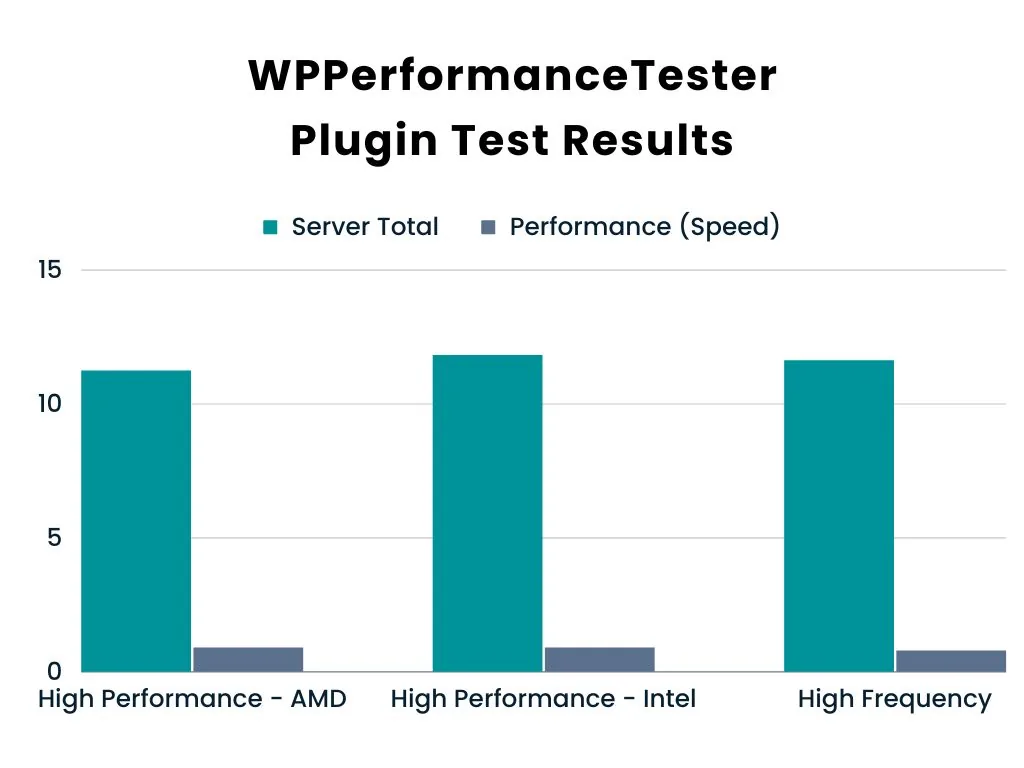
1. WPPerformanceTester Test Results:
- AMD High Performance server scores 0.904 seconds execution time.
- Intel High Performance server scores: 0.904 seconds execution time.
- High Frequency server scores: 0.798 seconds execution time.
High Frequency is the clear winner in this test with a total of 0.798 seconds execution time.
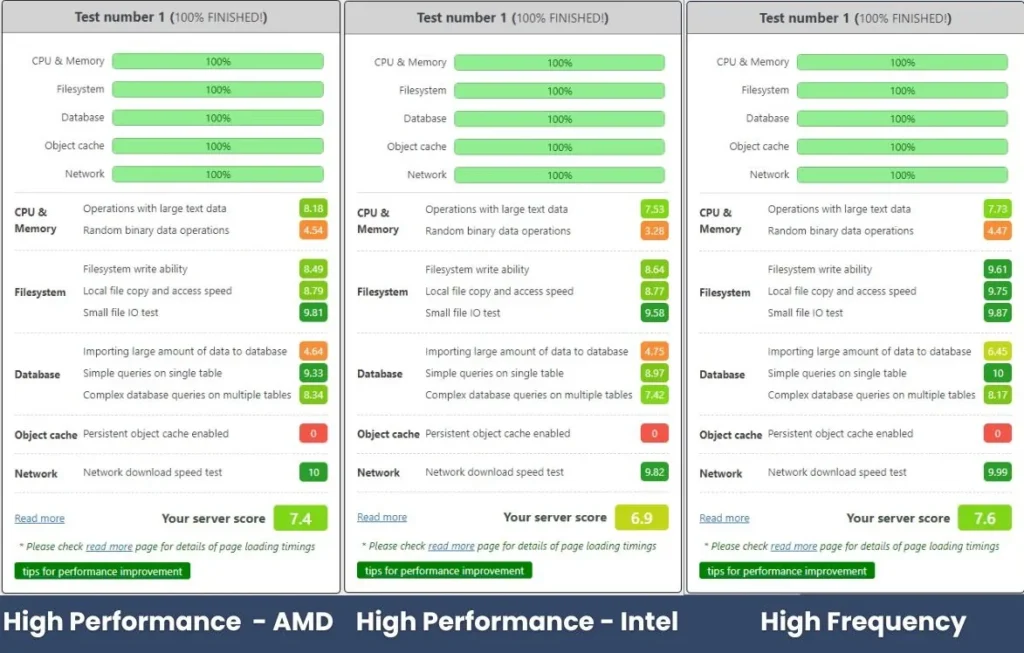
2. WordPress Hosting Benchmark Tool Test:
This test checks lots of criteria such as operations with large text data, importing large amounts of data to a database, random binary data operations, etc.
In this test, the server score is from 1 lowest to 10 highest. The more score you achieve the better.
- AMD High Performance: 7.4 server score.
- Intel High Performance: 6.9 server score.
- High Frequency: 7.6 server score.
Once again, the High Frequency server surprised us with better results.
3. GTmetrix:
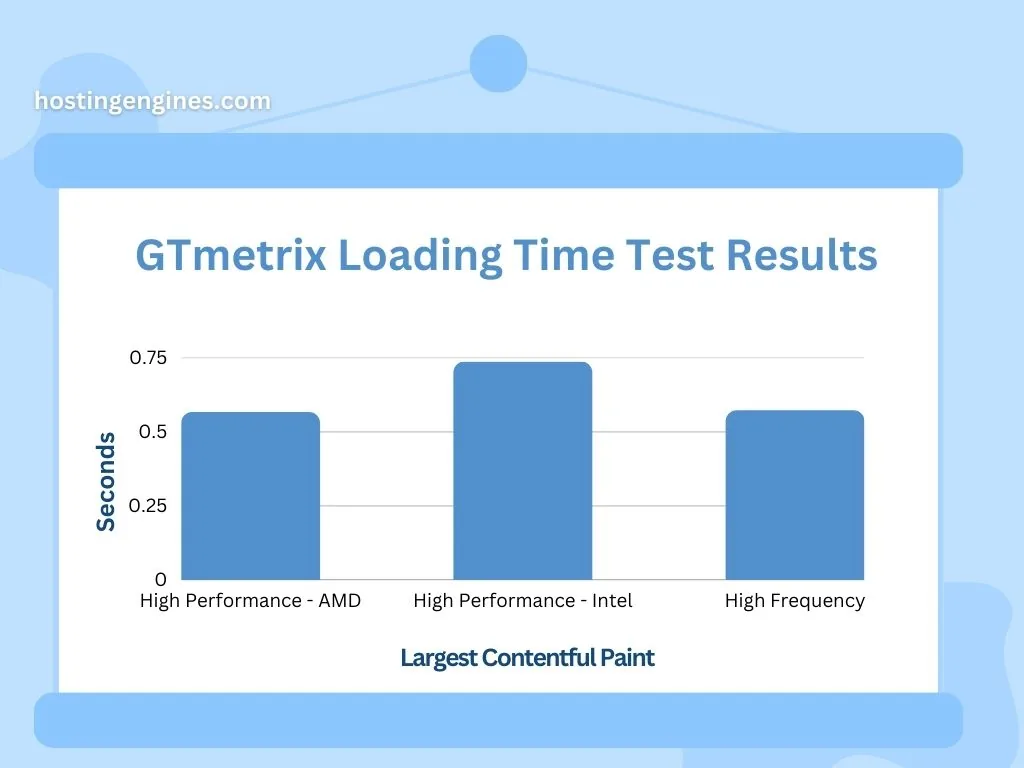
- AMD High-Performance Largest Contentful Paint: 0.565 loading time.
- Intel High-Performance Largest Contentful Paint: 0.736 loading time.
- High Frequency Largest Contentful Paint: 0.616 loading time.
Vultr High Performance Vs. High Frequency: Which Is Best?
From the tests above, the three servers are close to each other on performance, while the Intel High Performance is a little bit behind.
The Vultr High-Frequency servers tend to perform better than the other VPSs.
That was unexpected, since High Performance runs on newer-generation AMD EPYC and Intel Xeon CPUs, while High Frequency uses 3GHz+ Intel Xeon CPUs. The higher clock speed seems to pay off for WordPress.
If you have to choose one, I’d recommend the Vultr High-Frequency servers.
Click this link to get free credit on Vultr for new users.
Read also:
Install WordPress on Vultr.
Install PHP Script on Vultr.
DigitalOcean vs Vultr vs Linode.