


You want a host that won’t send you an overage bill or switch your site off the day a post goes viral. That’s what unlimited bandwidth hosting promises. The trouble is that “unlimited” is one of the most stretched words in web hosting, and the real limits sit somewhere else in the fine print.
So we opened the current plan pages, FAQs and policy pages of every host on this list and kept only the ones that still say unlimited, unmetered or “no bandwidth limits” today. For each one you’ll see the exact wording, the fair-use catch behind it, and what you’ll pay after the intro deal ends. Prices checked October 2026.
Some links below are affiliate links. If you buy through them we may earn a commission, at no extra cost to you. It doesn’t change which hosts make the list.
Quick answer: InMotion Hosting is the best all-round pick, because it pairs unmetered bandwidth with a visitor estimate for every plan and a 90-day refund. If you want to see the real CPU and RAM limits before you buy, choose Hosting.com. On a tight budget, DreamHost’s Launch plan is $1.99/month on a 4-year term and renews at a fairly gentle $7.99.
The best unlimited bandwidth hosting at a glance
| Host | Cheapest plan and wording | From | Renews at | Best for |
|---|---|---|---|---|
| InMotion Hosting | Launch, “Unmetered” | $4.79/mo (12 months) | $14.99/mo | Best overall, 90-day refund |
| DreamHost | Launch, “Unmetered” | $1.99/mo (48 months) | $7.99/mo | Low renewal, monthly billing |
| Hosting.com | Starter, “Unlimited” | $1.99/mo (48 months) | $13.99/mo | Published CPU, RAM and process limits |
| ScalaHosting | Mini, “No Bandwidth Limits” | $2.95/mo (12 or 36 months) | $11.95/mo | Anytime refund for unused time |
| ChemiCloud | Starter, “Unlimited” | $1.95/mo (36 months) | $11.95/mo | Lots of RAM, 45-day refund |
| Namecheap | Stellar, “Unmetered” | $2.28/mo (yearly) | $5.88/mo | Cheap without a long contract |
| HostGator | Hatchling, “Unmetered” | $3.75/mo (36 months) | $10.99/mo | 10 sites on the entry plan |
| InterServer | Standard, “Unlimited data transfer” | $2.50/mo (any term, 1 to 24 months) | $7/mo | Monthly billing at the intro price |
| Hostinger | Premium, “Unmetered” (FAQ) | $2.99/mo (48 months) | $10.99/mo | Beginners on a budget |
| Hostwinds | Basic, “Unlimited” | $6.99/mo (12 months) | $6.99/mo | Unlimited disk space too |
What unlimited bandwidth hosting really means
Bandwidth, or data transfer, is the data your site sends to visitors. Every page view, image and download counts. When a host says unlimited or unmetered, it means it doesn’t count your monthly transfer and won’t bill you per gigabyte. It does not mean a $3 plan can serve endless traffic. Our guide on what bandwidth is in web hosting covers the basics if you’re new to this.
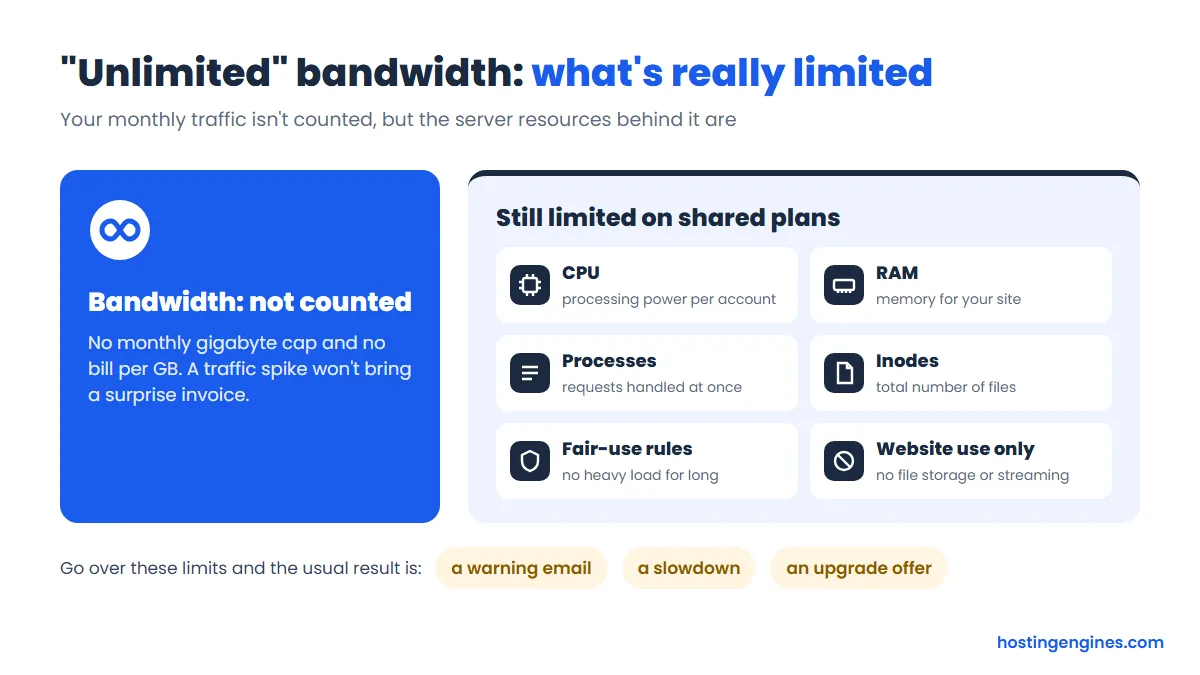
On shared hosting, the limits that actually bite are these:
- CPU, RAM and processes. A busy site runs out of processing power long before it runs out of “bandwidth”. Hosting.com, for example, lists 2 virtual CPUs, 2 GB of RAM and 30 processes on its Starter plan.
- Inodes (file count). ChemiCloud’s Starter plan allows 250,000 inodes, Namecheap’s Stellar and Stellar Plus 300,000, and Hosting.com’s Starter 200,000.
- Fair use rules. HostGator says you must not use 25% or more of system resources for longer than 90 seconds. DreamHost says fair-use and resource policies still apply, and Hostinger says its unlimited features are subject to its Fair Usage Policy.
- Website use only. InterServer says its plan is for websites and email, not backup storage, movie or file storage, or reselling. Namecheap bans storing, sharing or streaming large amounts of media on shared servers.
Go past those limits and a host will usually email you, slow the account down, or suggest a bigger plan. That’s how shared servers stay fast for everyone. The good news is that several hosts now publish a visitor estimate per plan, which is far more useful than the word “unlimited”. DreamHost even says it won’t cut you off if you go over the estimate.
Unmetered transfer still has real upsides, like no surprise bills after a traffic spike. We list them in the benefits of unlimited bandwidth.
1. InMotion Hosting
Best for: anyone who wants unmetered bandwidth and an honest idea of how much traffic each plan is built for.
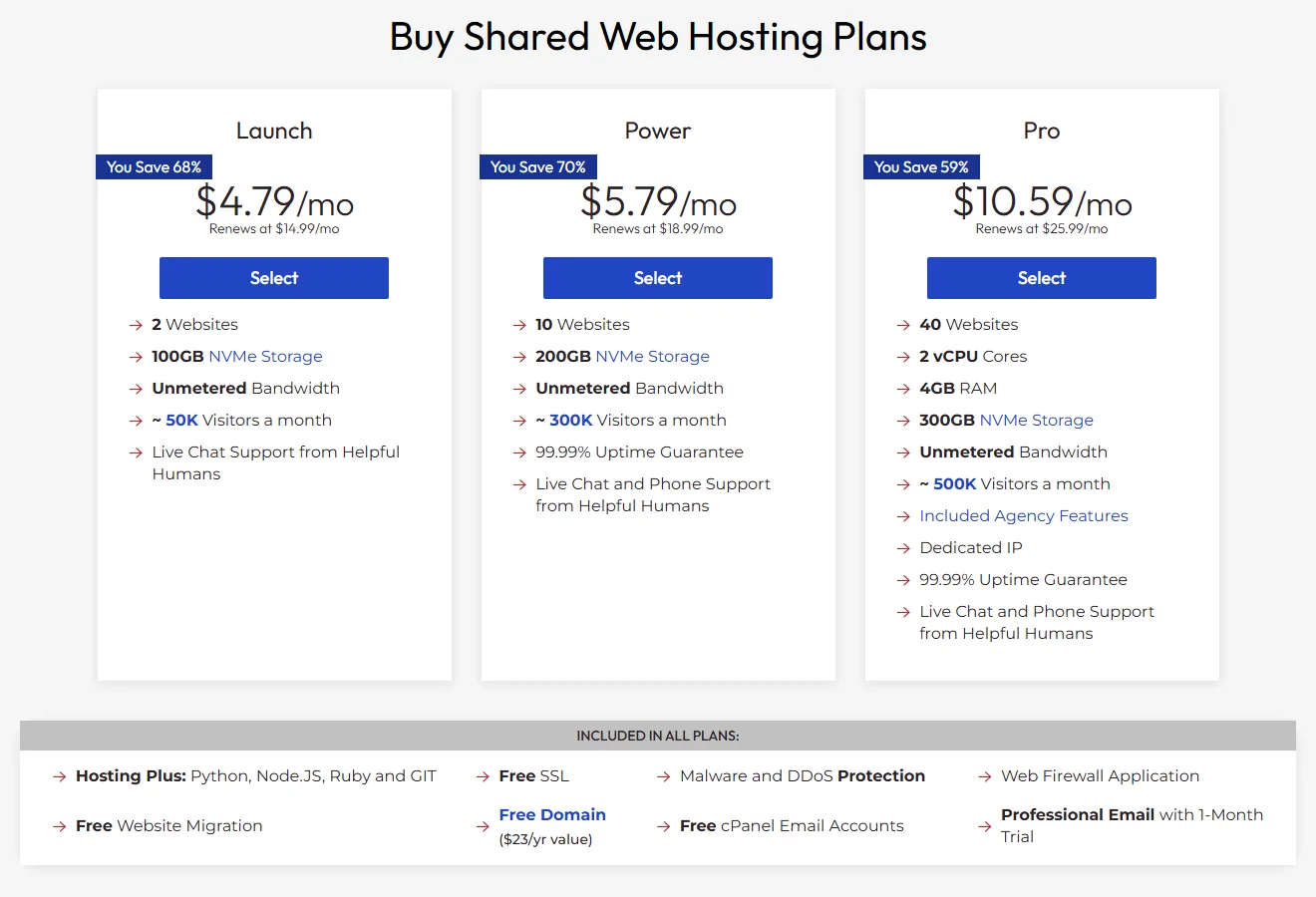
- “Unmetered” bandwidth on all three shared plans: Launch, Power and Pro.
- A traffic guide on every plan: about 50K visitors a month on Launch, 300K on Power and 500K on Pro.
- Plenty of storage: 100 GB NVMe on Launch, 200 GB on Power and 300 GB on Pro.
- A 90-day money-back guarantee, three times the usual 30 days.
We rank it first because it fills in the blank that “unlimited” leaves. The visitor estimate tells you roughly when to upgrade, and 90 days is long enough to watch your site through a few real traffic peaks before the refund window closes.
The catch: Launch hosts only 2 websites, and its renewal is a steep jump. Pro is the only shared plan that lists CPU and RAM (2 vCPU cores and 4 GB).
Price: Launch is from $4.79/month on a 12-month term and renews at $14.99/month. On a 2 or 3-year term it’s $4.99/month, renewing at $13.99/month. Read our InMotion Hosting review for the full picture.
2. DreamHost
Best for: bloggers and small businesses who want unmetered traffic, lots of sites and a renewal price that won’t sting.
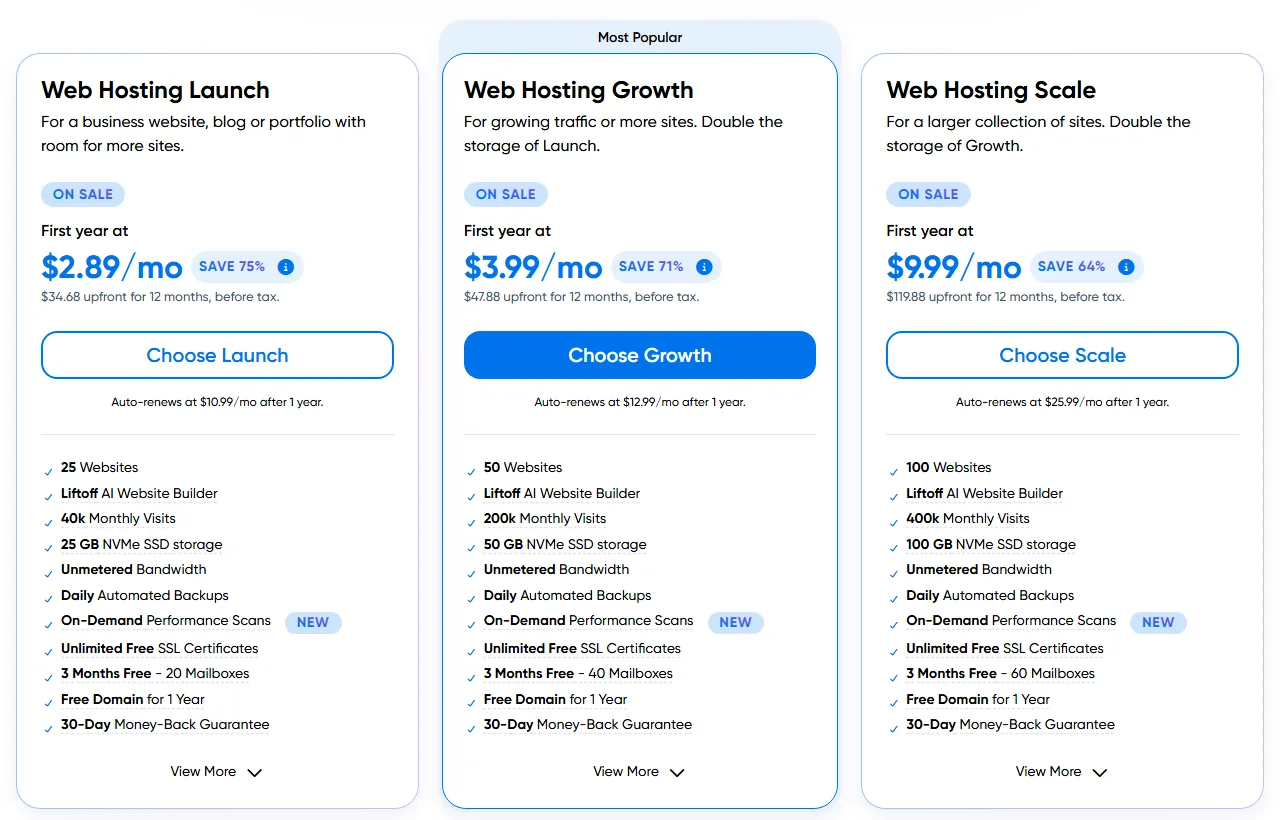
- “Unmetered” bandwidth on Launch, Growth and Scale, with no per-GB overage fees.
- Launch includes 25 websites and 25 GB NVMe storage. Growth has 50 sites and 50 GB, Scale 100 sites and 100 GB.
- Visit estimates of 40K, 200K and 400K a month. DreamHost says it won’t cut you off if you go over.
- Monthly billing on every web hosting plan, plus a 30-day money-back guarantee.
DreamHost is unusually plain about all this. Its pricing page says bandwidth has no per-GB overage fee but that fair-use and resource policies still apply, which is exactly what every host on this list means. The 4-year renewal of $7.99/month is one of the lowest here.
The catch: The cheapest rate needs a 4-year prepayment. Pay yearly and Launch is $2.89/month for the first year, then $10.99/month.
Price: Launch is from $1.99/month on a 48-month term and renews at $7.99/month. Growth is $3.49/month on the same term (renews at $8.99). Setting up WordPress? Our guide to creating a WordPress site on DreamHost walks you through it, and our DreamHost review covers the rest.
3. Hosting.com
Best for: anyone who wants to see the real resource limits behind “unlimited” before paying.
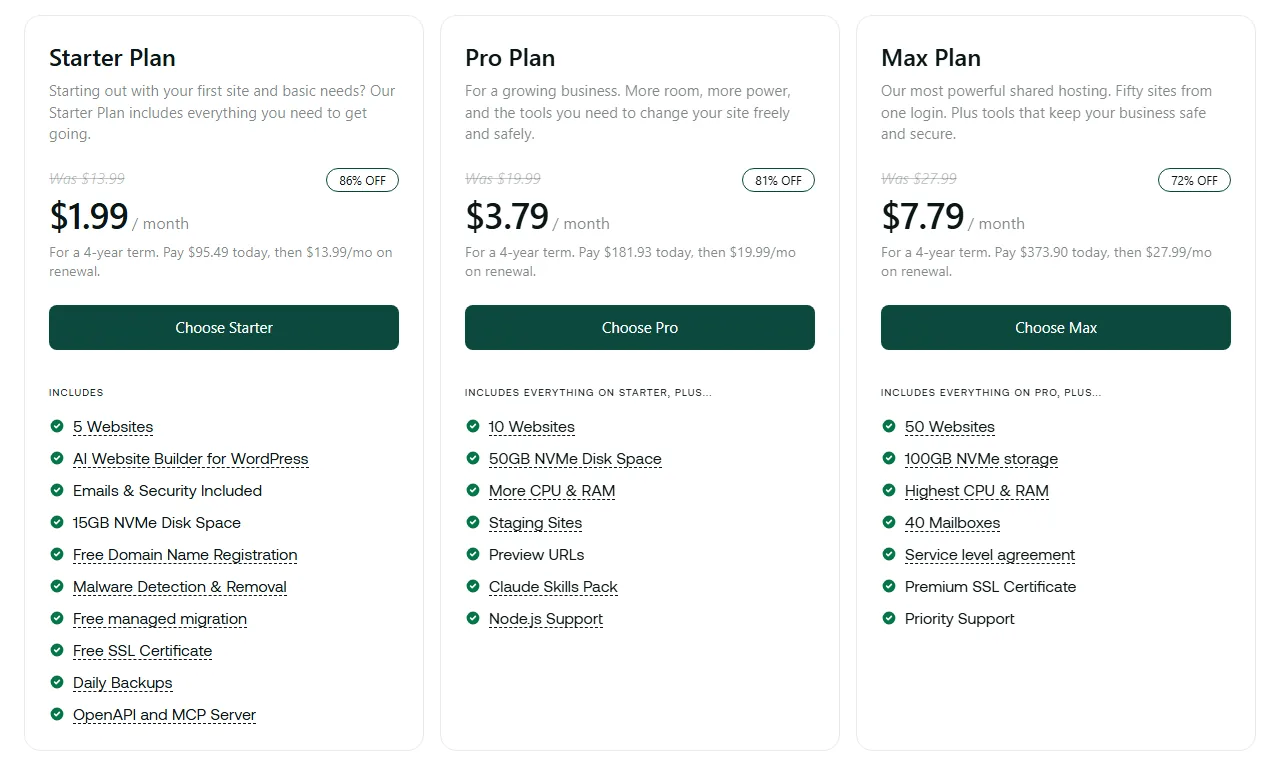
- “Unlimited” monthly bandwidth on Starter, Pro and Max.
- Starter: 5 websites, 15 GB NVMe storage and a guide of 50,000 monthly page views (150,000 on Pro, 500,000 on Max).
- Isolated resources with published numbers: 2 virtual CPUs, 2 GB RAM, 30 processes and 200,000 inodes on Starter.
- LiteSpeed caching, daily backups, free SSL, free managed migration and a 30-day money-back guarantee.
Hosting.com (formerly A2 Hosting) shows the limits that actually decide how much traffic you can serve. If your site starts to slow down, you’ll know whether it’s CPU, RAM or processes, and which plan fixes it.
The catch: 15 GB of storage on Starter is modest, and the renewal price only shows up at checkout, so look before you prepay four years.
Price: Starter is from $1.99/month on its longest (48-month) term and renews at $13.99/month. Our Hosting.com review goes deeper.
4. ScalaHosting
Best for: small business sites that want no bandwidth limits and a refund option that never runs out.
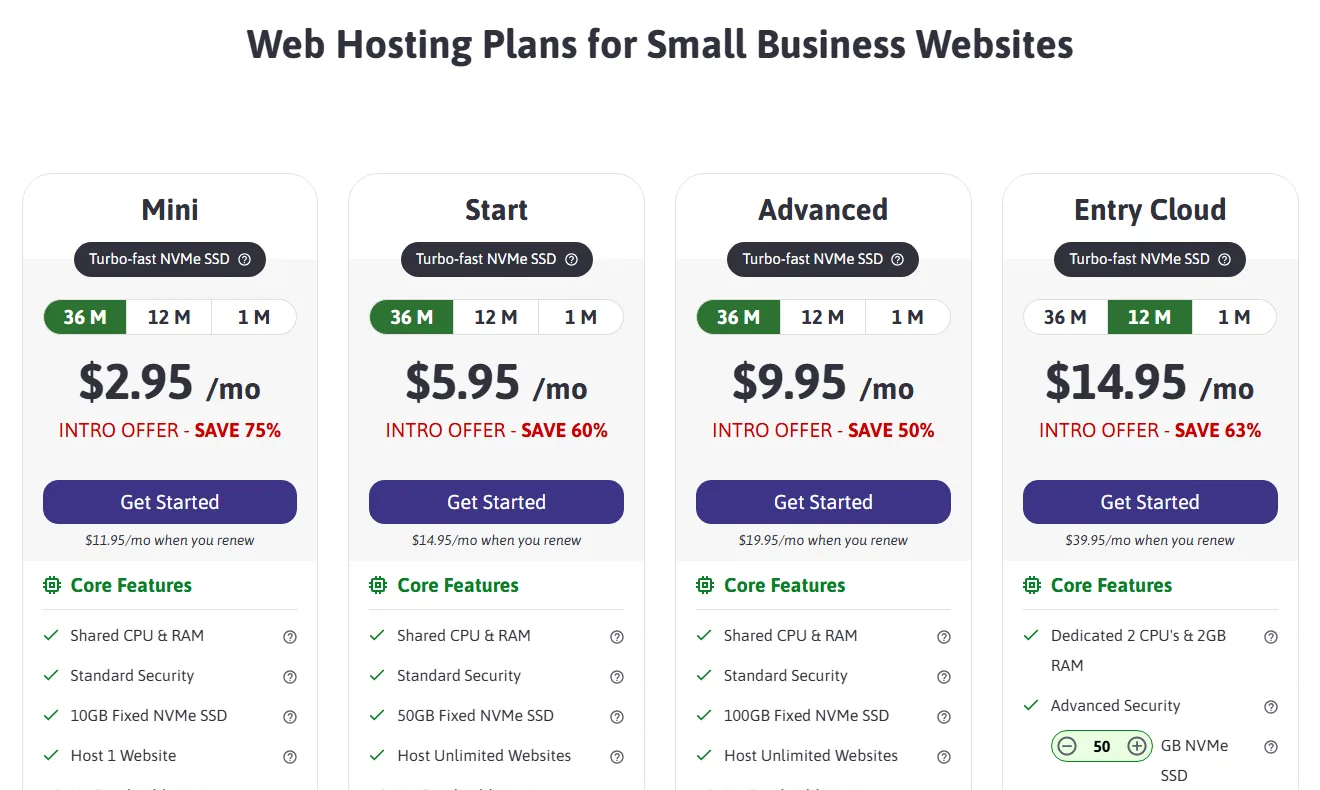
- “No Bandwidth Limits” on Mini, Start and Advanced.
- NVMe storage: 10 GB on Mini, 50 GB on Start and 100 GB on Advanced. Start and Advanced host unlimited websites.
- Intro and renewal prices printed right under each plan.
- An anytime money-back guarantee for the unused part of your term.
We like that the intro price is the same on a 12-month or 36-month term, so you don’t have to lock in for three years to get the deal.
The catch: Mini is tiny, with one site and 10 GB, and CPU and RAM are listed only as “shared”. For a site you expect to grow, Start is the realistic entry point.
Price: Mini is from $2.95/month on a 12 or 36-month term and renews at $11.95/month. Start is $5.95/month (renews at $14.95). See our ScalaHosting review.
5. ChemiCloud
Best for: people who want generous memory on a cheap plan, with unlimited bandwidth on every tier.
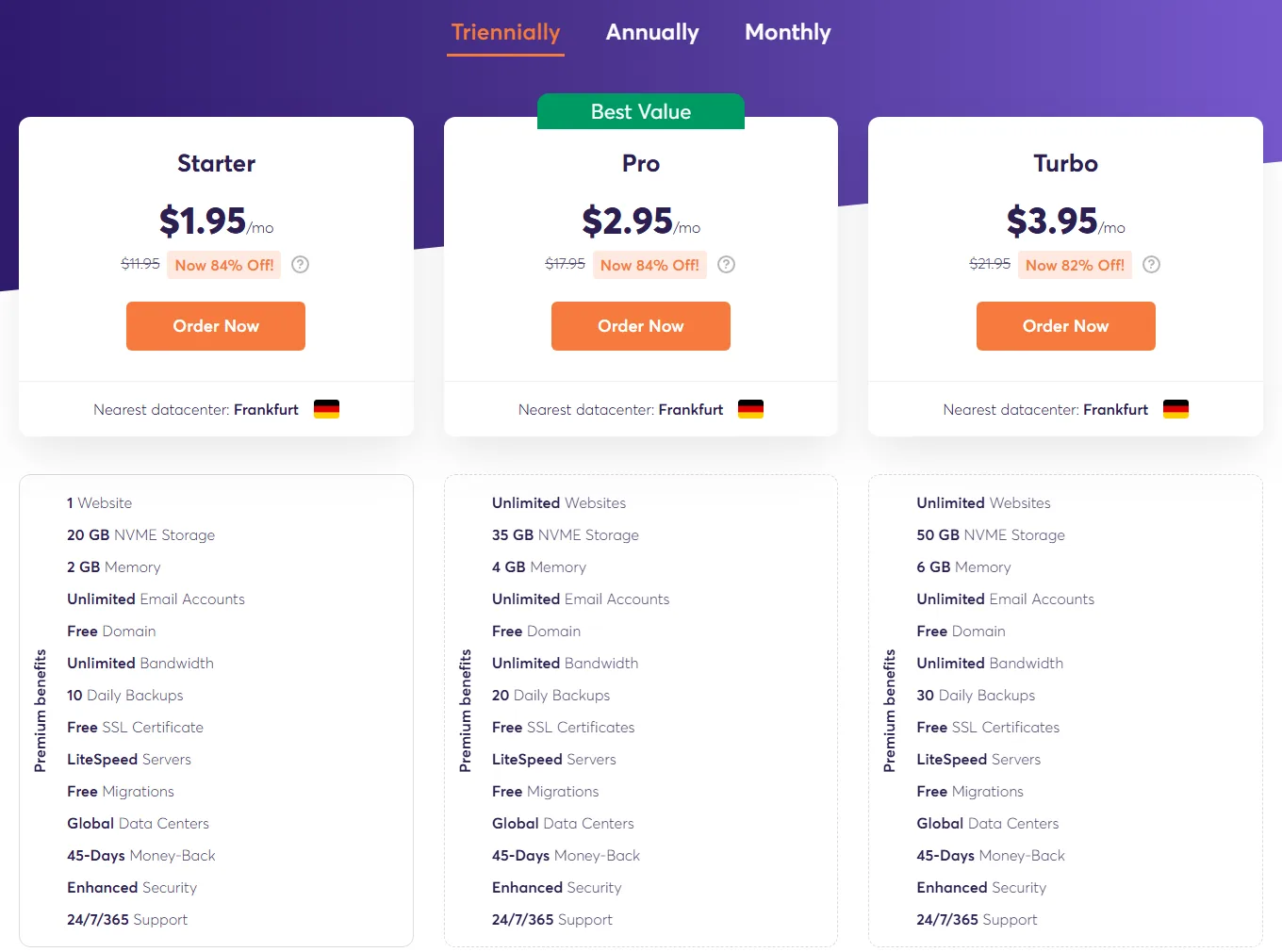
- “Unlimited” bandwidth on Starter, Pro and Turbo.
- Starter: 1 website, 20 GB NVMe storage, 1 CPU core and 2 GB RAM.
- Published inode limits: 250,000 on Starter, 350,000 on Pro and 500,000 on Turbo.
- A 45-day money-back guarantee.
2 GB of RAM on a $1.95 plan is generous, and ChemiCloud puts its CPU, RAM and inode numbers on the plan page instead of burying them. That makes it easy to plan around.
The catch: Starter allows one website, and the headline price comes with a 3-year prepayment. Promo prices renew at the regular rate, which is about six times higher.
Price: Starter is from $1.95/month on a 36-month term, with a regular price of $11.95/month. Pro is $2.95/month on the same term (regular $17.95).
6. Namecheap
Best for: budget buyers who’d rather pay yearly than lock in for three or four years.
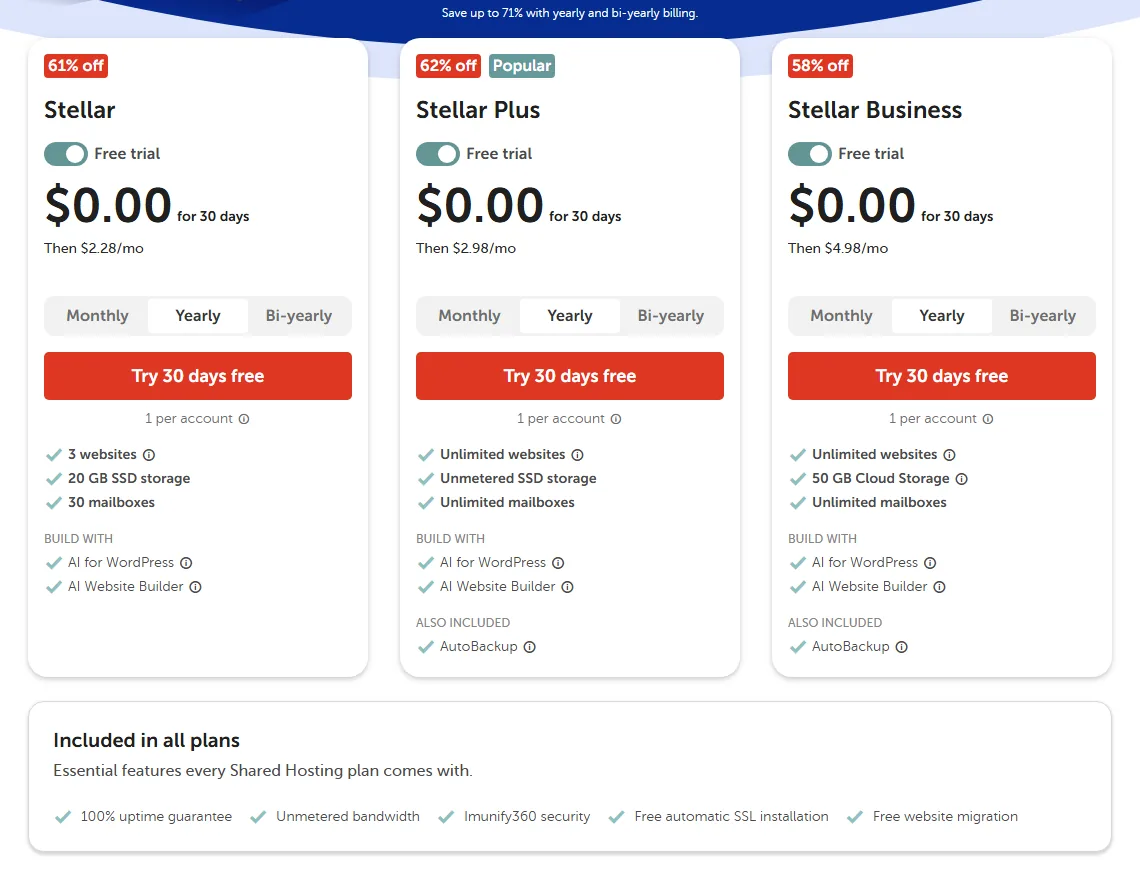
- “Unmetered bandwidth” included in Stellar, Stellar Plus and Stellar Business.
- Stellar hosts 3 websites with 20 GB SSD; Plus and Business host unlimited websites.
- Inode limits of 300,000 on Stellar and Plus, and 600,000 on Business.
- A 30-day free trial on shared plans right now (Namecheap calls it a limited-time offer).
You don’t need a long contract to get a low price here, and the renewal is one of the smallest jumps on this list. Namecheap is also honest about what unmetered means: it says it doesn’t strictly limit traffic but does set limits on CPU, memory, entry processes and inodes.
The catch: Namecheap may put constraints on accounts that hurt server performance, and it doesn’t allow storing or streaming large amounts of media. Fine for a blog, not for a video site.
Price: Stellar is from $2.28/month billed yearly ($26.88 for the first year), against a regular price of $5.88/month. Stellar Plus is $2.98/month (regular $7.88).
7. HostGator
Best for: people who want to run several small sites from one cheap account.
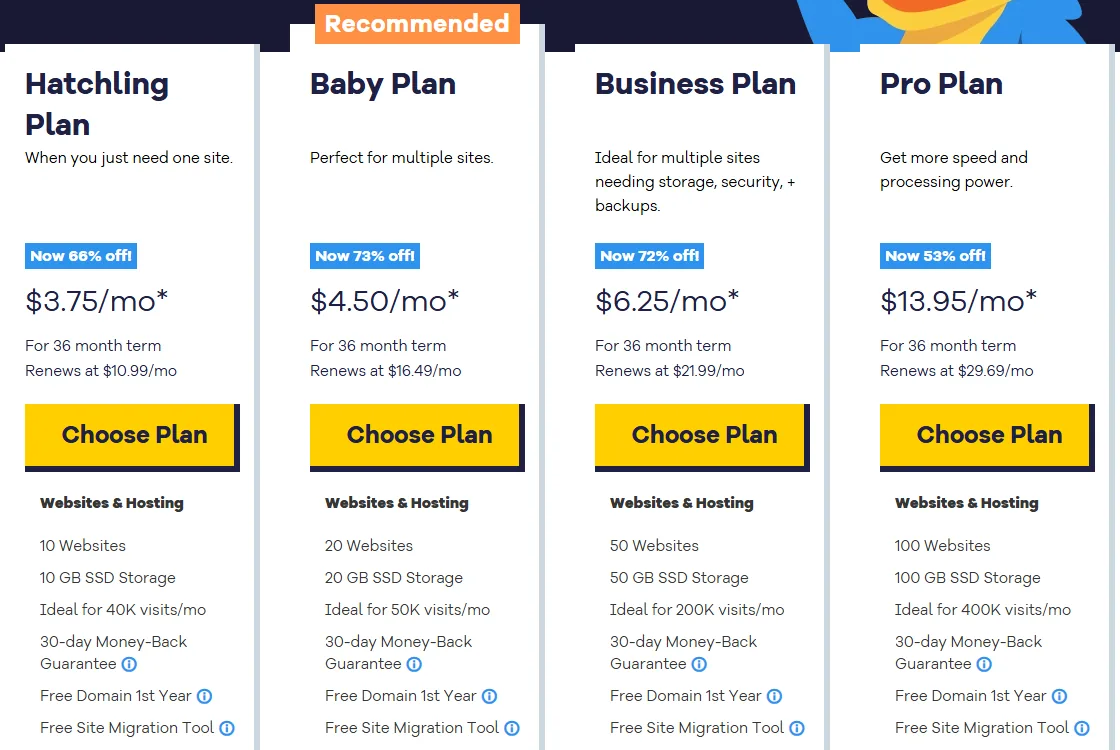
- “Unmetered” bandwidth on Hatchling, Baby and Business.
- Hatchling includes 10 websites, 10 GB SSD storage and is pitched as ideal for about 40K visits a month.
- Free domain for the first year, free Cloudflare CDN and a 30-day money-back guarantee.
Ten sites on the entry plan is a lot. HostGator is also the most explicit about what unmetered means: you aren’t charged for the bandwidth a normal personal or small business site uses.
The catch: The same page says you must not use 25% or more of system resources for longer than 90 seconds. A busy WooCommerce store could hit that. Storage on Hatchling is small, too.
Price: Hatchling is from $3.75/month on a 36-month term and renews at $10.99/month. Baby is $4.50/month (renews at $16.49). More in our HostGator review.
8. InterServer
Best for: people who want unlimited data transfer without prepaying for years.
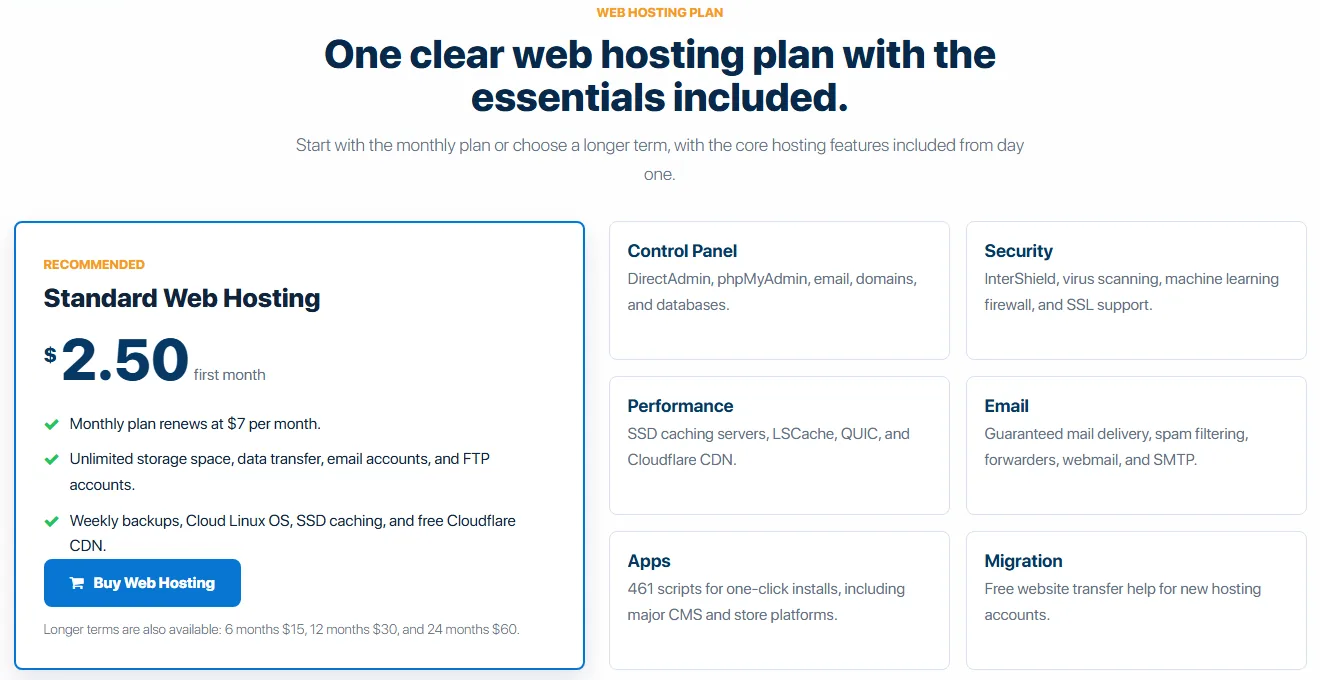
- One Standard Web Hosting plan with unlimited storage and data transfer.
- The same $2.50/month on a 1, 6, 12 or 24-month term.
- Unlimited email and FTP accounts, weekly backups, CloudLinux, SSD caching and free Cloudflare CDN.
- DirectAdmin control panel and free migration help.
InterServer keeps it simple. There’s one plan, the renewal price sits right next to the intro price, and you can start on a single month. That’s rare at this price.
The catch: “Unlimited” is for normal website and email use. InterServer says the plan isn’t for backup storage, file storage or reselling, and it doesn’t publish CPU or RAM numbers. If you prefer cPanel, note that this plan uses DirectAdmin.
Price: Standard is $2.50/month on any term up to 24 months ($30 for 12 months) and renews at $7/month.
9. Hostinger
Best for: beginners who want a cheap, easy plan and don’t expect big traffic yet.
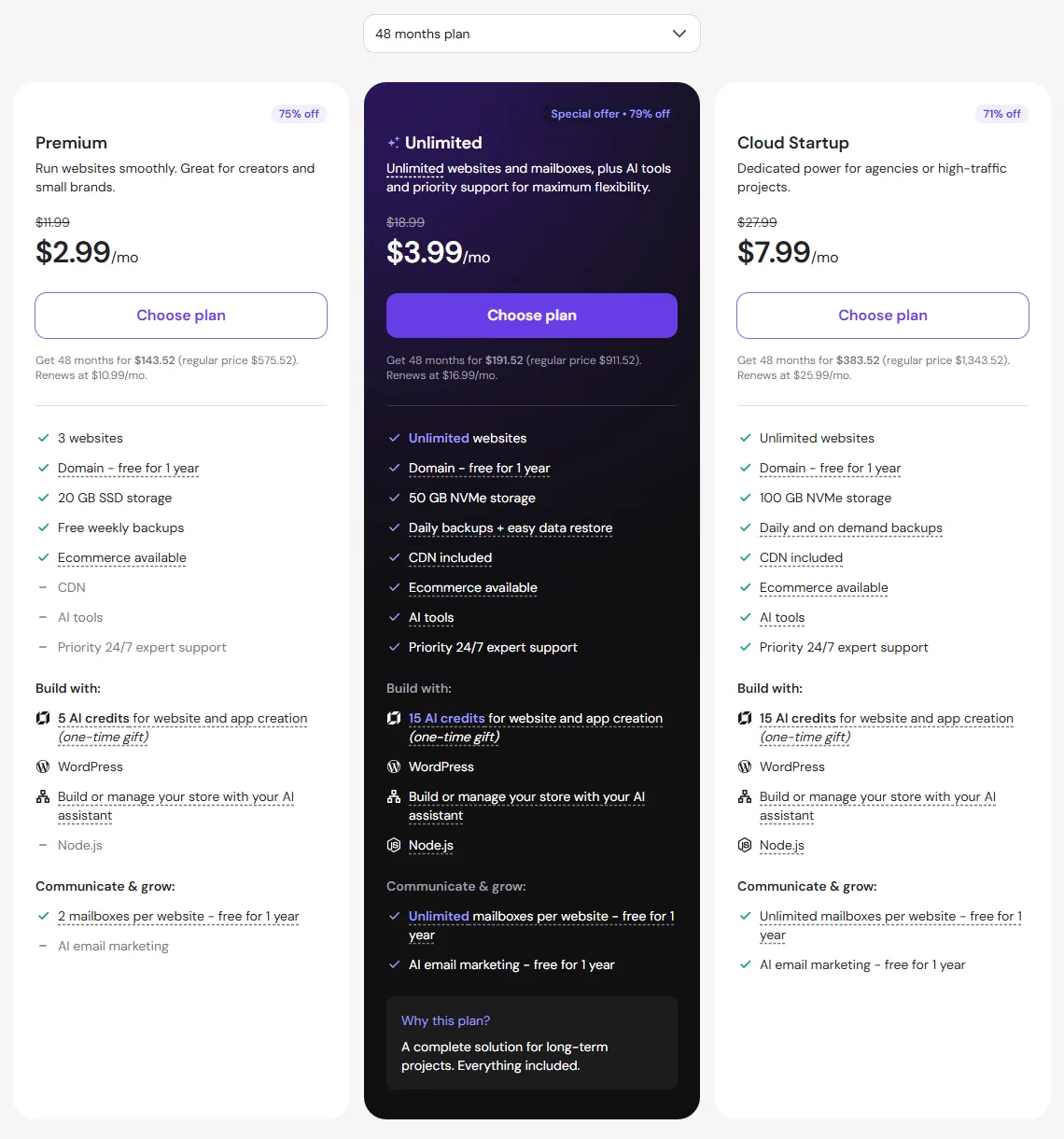
- Hostinger’s FAQ says Premium comes with unmetered bandwidth, and its feature list says “Handle traffic spikes with unlimited bandwidth”.
- Premium includes 3 websites, 20 GB SSD storage, weekly backups and a free domain for the first year.
- The Unlimited plan above it adds unlimited websites, 50 GB NVMe and daily backups.
- 30-day money-back guarantee.
The hPanel dashboard is one of the easiest to learn, and the price is hard to beat if you commit for four years.
The catch: This is why Hostinger sits near the bottom. Bandwidth isn’t listed on the plan cards at all, only in the FAQ and the general feature list, and Hostinger says its unlimited features are subject to its Fair Usage Policy. It qualifies on wording, but don’t treat Premium as a high-traffic plan.
Price: Premium is from $2.99/month on a 48-month term ($143.52 upfront) and renews at $10.99/month. Our Hostinger review has the details.
10. Hostwinds
Best for: people who want unlimited bandwidth and unlimited disk space with no renewal shock.
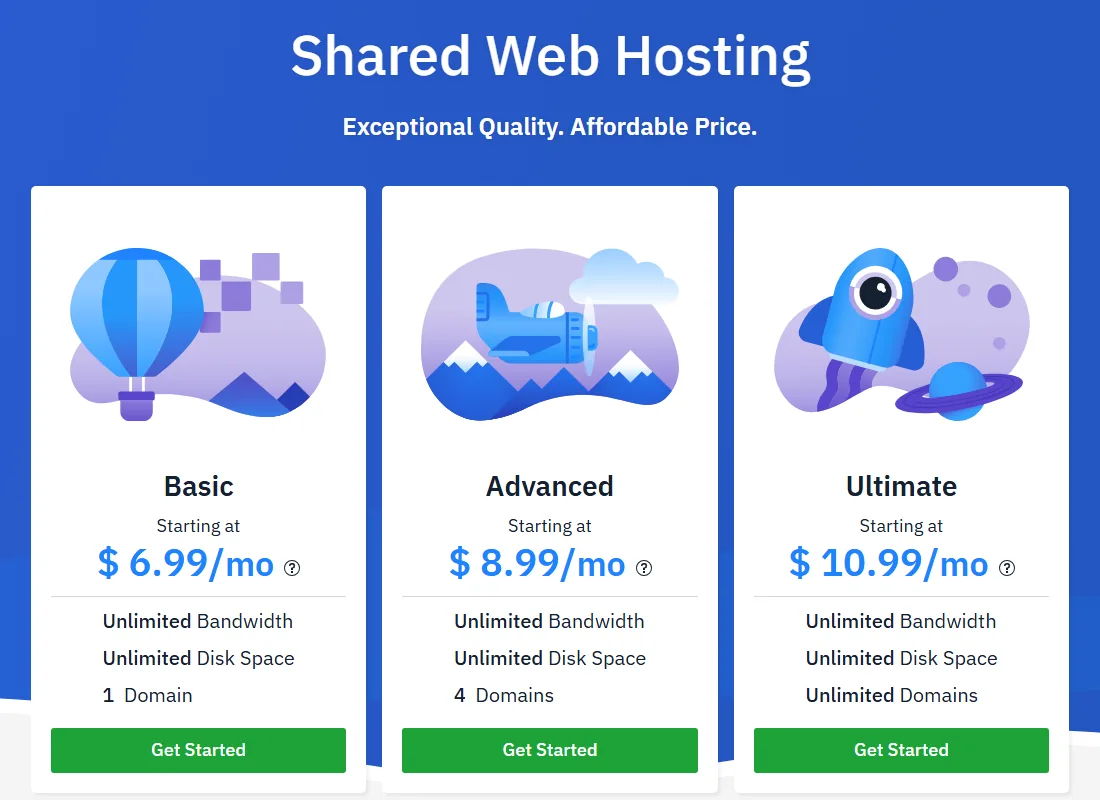
- “Unlimited” bandwidth and “Unlimited” disk space on Basic, Advanced and Ultimate.
- Basic covers 1 domain, Advanced 4 and Ultimate unlimited.
- cPanel with Softaculous, free SSL, a free dedicated IP and free website migration.
The plans are easy to compare because the only thing that changes is the number of domains. And the advertised $6.99 is the regular annual rate, so there’s no renewal jump hiding behind it.
The catch: It’s the priciest entry plan on this list, and Basic allows just one domain. If you only run one site, cheaper hosts above give you more for less in year one.
Price: Basic is from $6.99/month billed annually ($83.88 a year). Hostwinds sometimes applies a first-term discount at checkout, so check your cart.
Other hosts that say unlimited or unmetered (and why they’re not in our top 10)
Plenty of hosts use the word. These ones do too, but we think the ten above are better buys for most people:
- SiteGround. Every plan says “unlimited traffic”, but SiteGround’s own FAQ says StartUp supports around 10,000 visits a month, and StartUp renews at $17.99/month after the $2.99 first year.
- GreenGeeks. “Unmetered traffic” on its shared plans, from $2.95/month on a 12-month term, but it renews at $13.95/month.
- GoDaddy. Its Web Hosting plans include “Unmetered bandwidth”, but the Economy plan hosts a single site and GoDaddy shows prices in your local currency, so check the renewal before you buy.
- Web.com and Fasthosts. Web.com’s hosting page now sends you to Network Solutions, which lists “Unmetered Bandwidth”. Fasthosts says “Unlimited bandwidth” on every plan, but it’s a UK host priced in pounds.
- Bluehost. Its shared plans list storage and a visits-per-month estimate but don’t promise unmetered bandwidth. Our Bluehost review covers it if you’re curious anyway.
- JustHost and A2 Hosting. JustHost is now part of Bluehost, and A2 Hosting is now Hosting.com, which is already on the list.
How to choose an unlimited bandwidth web host
Since every host above says unlimited or unmetered, the word itself won’t help you pick. These things will:
- Estimate your real traffic. Multiply your average page size by your monthly page views. A 2 MB page viewed 10,000 times is about 20 GB a month. Our free Bandwidth Calculator does the math, and our guide on how much hosting bandwidth your website needs explains each step.
- Check the visitor estimate. InMotion, DreamHost, Hosting.com and HostGator all publish one. It’s the closest thing to a real traffic limit you’ll get on shared hosting.
- Look for the limits that actually apply. CPU, RAM, processes and inodes decide how much you can serve. Hosts that publish them (Hosting.com, ChemiCloud, Namecheap) are easier to plan around.
- Compare renewal prices, not intro prices. A $1.95 plan that renews at $11.95 costs more over five years than a $2.50 plan that renews at $7. Our list of the best cheap web hosting digs into this.
- Use the refund window. InMotion gives 90 days, ChemiCloud 45, ScalaHosting anytime for unused time, and most others 30. Test your site under real traffic before it closes.
- Add a CDN. A CDN serves your images and files from its own servers, which takes load off your host. Here’s why it helps: benefits of using a CDN with your hosting.
If your site keeps outgrowing shared hosting no matter what the plan page says, it’s time for fixed resources. Start with shared hosting vs VPS hosting, or jump to our list of the best cloud hosting services.
FAQ
Is unlimited bandwidth hosting really unlimited?
No. The host doesn’t count your data transfer or charge overage fees, but your account is still limited by CPU, RAM, processes and fair-use rules. If your site uses too much of the shared server, the host will usually ask you to upgrade.
What’s the difference between unlimited and unmetered bandwidth?
In practice, very little. Both mean the host doesn’t measure your monthly transfer against a cap. “Unmetered” is a bit more honest, because it says the host doesn’t meter it, not that the resources behind it are endless.
Which host has the cheapest unlimited bandwidth plan?
ChemiCloud has the lowest headline price at $1.95/month, but only on a 3-year term. Over the long run, DreamHost ($1.99 on 4 years, renews at $7.99) and InterServer ($2.50 on any term, renews at $7) cost less.
How much bandwidth does a small website need?
Usually far less than you’d think. A 2 MB page viewed 10,000 times a month uses about 20 GB. Run your own numbers in our Bandwidth Calculator to see where you stand.
Will my host suspend my site after a traffic spike?
A short spike is usually fine. Problems start when heavy use lasts, like HostGator’s rule against using 25% of system resources for more than 90 seconds. Caching and a CDN make a big difference here.
Can I host videos or large downloads on unlimited bandwidth hosting?
Not really. Shared hosts mean “unlimited” for normal websites: Namecheap bans storing or streaming large amounts of media, and InterServer excludes file storage. For video, use a video platform or a CDN, or move to a VPS.