

An SSL certificate provides a secure connection between websites and website visitors in order to protect the user’s information in the first place. But does that really impact your website’s SEO?
If your website isn’t secured with SSL and doesn’t have an HTTPS version, browsers warn visitors that the site is not secure. Chrome has shown a “Not secure” label on every HTTP page since 2018, and Google said Chrome 154 (October 2026) turns on “Always Use Secure Connections” by default, which asks visitors for permission before opening an HTTP-only public site. So, not having an SSL certificate on your website will surely hurt the user experience.
But that’s not the focus of this article. The big question here is whether having an SSL certificate installed on your website makes any difference in search engine results, especially on Google.
What is an SSL Certificate?
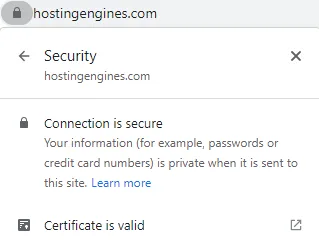
Secure Sockets Layer or “SSL” is the original protocol for creating a secure, encrypted path between two devices over the internet or an internal network. An SSL certificate is the file a website uses to prove its identity and set up that encrypted connection.
Strictly speaking, today’s connections use TLS (Transport Layer Security), the successor to SSL, but everyone still calls the certificates “SSL certificates”. A website with a certificate installed is served over HTTPS instead of HTTP. For more detail, read our guide on how SSL/TLS certificates work.
HTTP is exposed to attacks because all of the information sent between the web browser and the server travels as plain, readable text. With HTTPS, where “the S stands for secure”, that data is encrypted, so anyone intercepting it can’t read or change it.
Types of SSL Certificates
There are three different types of SSL certificates validation, there are:
- Domain validation: which is the least level of validation and the cheapest.
- Organization validation: it is a more hands-on process and is more trustworthy.
- Extended validation: which requires a full background check
The difference between them is the level of identity checking before the certificate is issued and the amount of money you pay for each one. The encryption itself is just as strong with all three.
Is SSL Certificate Important for Website Ranking?
Search Engine Optimization also known as SEO is basically a strategy that uses keywords, content, page speed, HTML, etc. that will enable websites to be positioned better in search engine result pages also known as SERP.
The main intention is to be placed on the first page in google search results because when searching for anything online most people click on the first result or link that appears.
So, it is extremely essential to do everything within your power to enhance your website for search engines to at least appear on the first page.
One of the first steps in improving your website should be getting an SSL certificate, both for your visitors and for SEO.
In August 2014, Google announced that it would start using HTTPS as a ranking signal, saying security is a top priority. But it was clear from day one that this would be a small signal.
As they mentioned “HTTPS as a ranking signal. For now, it’s only a very lightweight signal—affecting fewer than 1% of global queries, and carrying less weight than other signals such as high-quality content —while we give webmasters time to switch to HTTPS”
Google added that it might strengthen the signal over time, to encourage every website owner to switch from HTTP to HTTPS (HTTP over SSL/TLS).
So, what happened since 2014? Google never announced a stronger HTTPS signal. In 2021 it grouped HTTPS with Core Web Vitals and mobile-friendliness under “page experience”, and in 2023 it removed the separate page experience and secure-site systems from its list of ranking systems. Its current page experience guide still asks site owners whether their pages are “served in a secure fashion”, while saying Core Web Vitals are what its ranking systems use directly. In plain terms: HTTPS is expected, the direct boost is tiny, and the real wins are trust and no browser warnings.
That means websites that use HTTPS (and therefore have an SSL certificate) can get a slight ranking boost from Google, which can help their SEO a little, all else being equal. Google Search Central explains it in this video.
Is the Free Let’s Encrypt SSL certificate Good for SEO?
Google’s John Mueller said back in 2014 that the price of an SSL certificate and its validation level don’t matter to Google. An EV certificate may make sense for your users, but for search, what counts is a properly secured HTTPS connection.
So, free or paid makes no difference for SEO. The free Let’s Encrypt SSL certificate that most hosts install automatically, or the free Cloudflare SSL certificate, will do just fine. Just make sure it renews automatically: Let’s Encrypt certificates last 90 days, and the industry-wide maximum dropped to 200 days in March 2026.
SSL and SEO: The Conclusion
An SSL certificate moves a website from HTTP to HTTPS (HTTP over SSL/TLS), which protects visitors’ data from third parties trying to intercept it.
Google has used HTTPS as a lightweight ranking signal since 2014, so an SSL certificate can give you a slight edge. The bigger benefit for SEO is indirect: no “Not secure” warnings, more trust, and fewer visitors bouncing away.
Using a free or premium SSL certificate doesn’t reflect any difference. You just need any type of SSL certificate and you are good to go.
Finally, keep an eye on your certificate’s expiry date with our free SSL checker tool, or monitor your SSL certificate and uptime automatically with a service such as Uptime Robot.
Read Also: