
Most people know Namecheap as the place they bought a domain. It also sells shared hosting, and the pitch is simple: cheap plans, cPanel, and a 30-day free trial. This Namecheap hosting review looks at what you actually get, what it costs after the first term, and the small print that catches people out.
A quick note on how we wrote it: this review is based on Namecheap’s own plan pages, knowledgebase articles and legal terms, all checked in October 2026. We haven’t run our own speed or uptime tests on Namecheap, so you won’t find invented benchmark numbers here.
Quick Verdict
Short answer: Namecheap is a fair pick for a small site, a first blog, or a domain you already keep there, especially if you want to try hosting for a month before paying. It’s less of a bargain once it renews, the free SSL only lasts a year, and support is chat and tickets only.
| Best for | Small sites, personal blogs, portfolios, people who already use Namecheap for domains |
| Shared plans | Stellar, Stellar Plus, Stellar Business |
| Starting price | From $1.88/month (2-year term) or $2.28/month (1-year term), after a 30-day free trial |
| Renewal | Stellar renews at $55.88/year (about $4.66/month) |
| Money-back | 30 days, but not if you started with the free trial |
| Control panel | cPanel with Softaculous |
| Data centers | US, UK, EU and Singapore |
| Support | 24/7 live chat and email/tickets, no phone |
| Our take | Good value for small, simple sites. Read the renewal and SSL terms before you commit. |
About Namecheap
Namecheap is a US-based, ICANN-accredited domain registrar headquartered in Phoenix, Arizona, and it has been serving customers since 2001. Many of its staff come from or work in Ukraine, which the company mentions on every page.
Domains are still the core business. Hosting came later, and it shows in a good way and a bad way. The good: domain, hosting, email and SSL all sit in one account, which is genuinely handy. The bad: the hosting side has more fine print than you’d expect from a brand with “cheap” in its name.
Who Is Namecheap Hosting For?
- You’re launching your first blog, portfolio or small business site and want to keep costs low.
- Your domain is already at Namecheap and you’d like everything in one dashboard.
- You want to try a host for a month without paying anything up front.
- You’re comfortable with cPanel, or happy to learn it.
It’s a weaker fit if you need phone support, run a busy online store, or want the lowest possible price over three or four years. For long-term cost, a few rivals lock in a cheap rate for longer.
Pros and Cons
Pros
- 30-day free trial: you can try any shared plan for a month at $0.
- Low starting prices, and a monthly plan if you don’t want to commit.
- cPanel and Softaculous, so WordPress is a one-click install.
- Four data center regions, which is more choice than many budget hosts give you.
- Unmetered bandwidth and Imunify360 security on every shared plan.
- AutoBackup with daily, weekly and monthly restore points on Stellar Plus and Stellar Business.
- Free website migration from another cPanel host.
Cons
- Free SSL is for the first year only. After that you pay for a certificate.
- Renewal prices are roughly double the intro rates, and the discount never applies to renewals.
- Start with the free trial and you lose the 30-day money-back guarantee.
- No phone support.
- The entry Stellar plan has no AutoBackup, only backups twice a week.
Namecheap Shared Hosting Plans and Prices
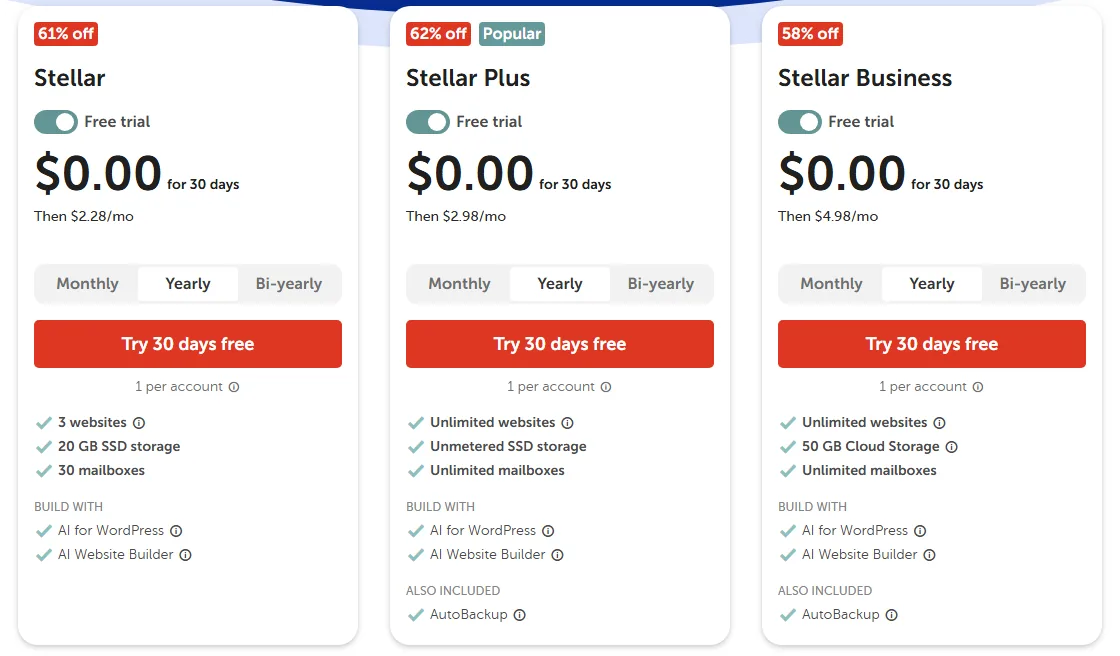
Namecheap sells three shared plans: Stellar, Stellar Plus and Stellar Business. Every one of them can start with a 30-day free trial, then you pay the “after trial” price for the term you picked. Prices checked October 2026.
| Plan | Monthly term | 1-year term | 2-year term | Renews at (1 year) |
|---|---|---|---|---|
| Stellar | $5.88/mo | $2.28/mo | $1.88/mo | $55.88/yr (about $4.66/mo) |
| Stellar Plus | $7.88/mo | $2.98/mo | $2.28/mo | $85.44/yr (about $7.12/mo) |
| Stellar Business | $11.88/mo | $4.98/mo | $4.48/mo | $128.88/yr (about $10.74/mo) |
Two-year renewals are a little cheaper per month: $102.88 for Stellar, $146.44 for Stellar Plus and $251.88 for Stellar Business. Monthly plans renew at the same monthly price, so there’s no surprise jump there, just a higher price from day one.
Namecheap raised its shared hosting renewal prices on May 19, 2026, and its own terms say the advertised discount “does not apply to renewals.” So if you see an old review quoting cheaper renewals, it’s out of date.
Our honest take on pricing: the two-year Stellar plan is the sweet spot for a small site. You get the lowest rate for the longest time Namecheap offers. If you’d rather not commit, the monthly plan is fair, but you’ll pay more than double the yearly rate. Not sure which billing cycle makes sense? Pick the longest term you are confident you will stay for.
What each plan includes
| Feature | Stellar | Stellar Plus | Stellar Business |
|---|---|---|---|
| Websites | 3 | Unlimited | Unlimited |
| Storage | 20 GB SSD | Unmetered SSD | 50 GB (cloud storage) |
| File limit (inodes) | 300,000 | 300,000 | 600,000 |
| Mailboxes | 30 | Unlimited | Unlimited |
| Subdomains | 30 | Unlimited | Unlimited |
| Bandwidth | Unmetered | Unmetered | Unmetered |
| Backups | Twice a week | Twice a week + AutoBackup | Twice a week + AutoBackup |
| Free SSL | First year | First year | First year |
| Dedicated IP | $4.00/mo add-on | $4.00/mo add-on | $4.00/mo add-on |
“Unmetered” storage on Stellar Plus still has rules. Namecheap’s terms say the space is meant only for your website and must follow its Acceptable Use Policy, and the 300,000 file limit applies either way. In practice, the inode cap is the limit you’d hit first on a big WordPress site.
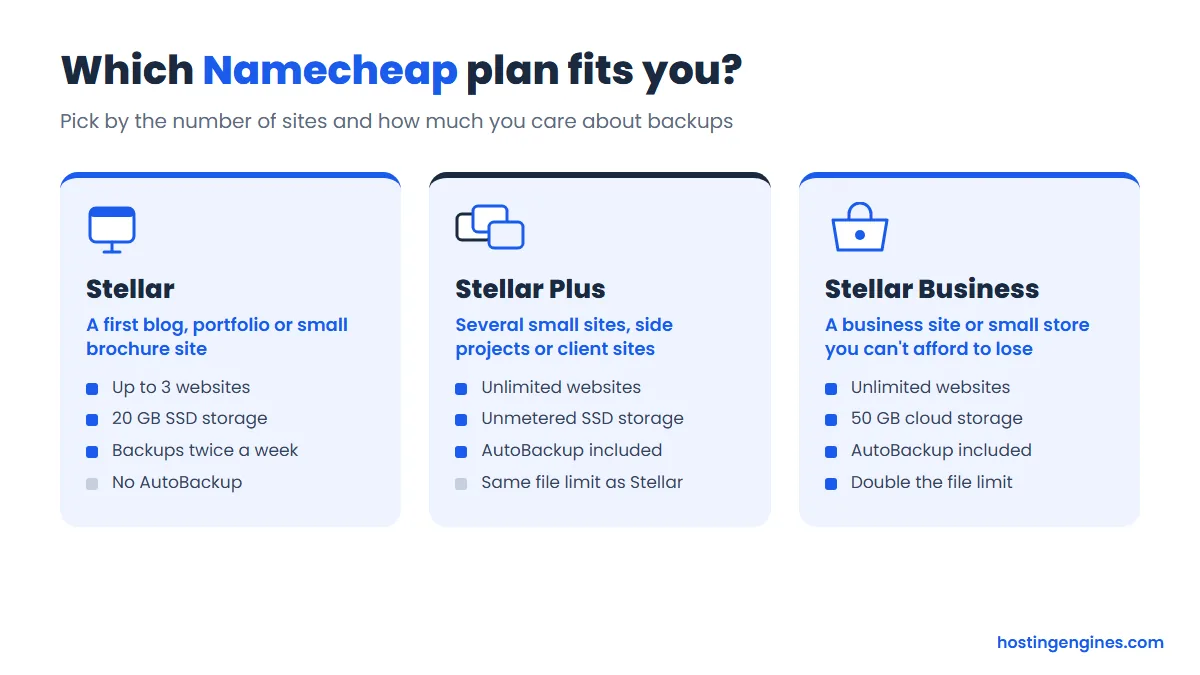
For most readers, our pick is Stellar Plus. It costs a little more than Stellar, but AutoBackup alone is worth the gap. Stellar Business makes sense when the site earns money and you want the extra file headroom.
The 30-Day Free Trial and the Money-Back Rules
This is the part most people skim, and it matters. Namecheap gives you two ways to “try before you commit,” but you can’t stack them.
- Free trial: 30 days at $0, available on monthly, yearly and two-year terms, with one trial per term per household.
- 30-day money-back guarantee: a full refund within 30 days, but only for first-time shared hosting customers who did not start with the trial.
- No refund if you opened a second Namecheap account, or closed an old account and signed up again.
- Renewals are refundable only if you cancel within 48 hours. After that, a prorated refund is “upon consideration.”
- Third-party licenses such as cPanel or Softaculous aren’t refundable.
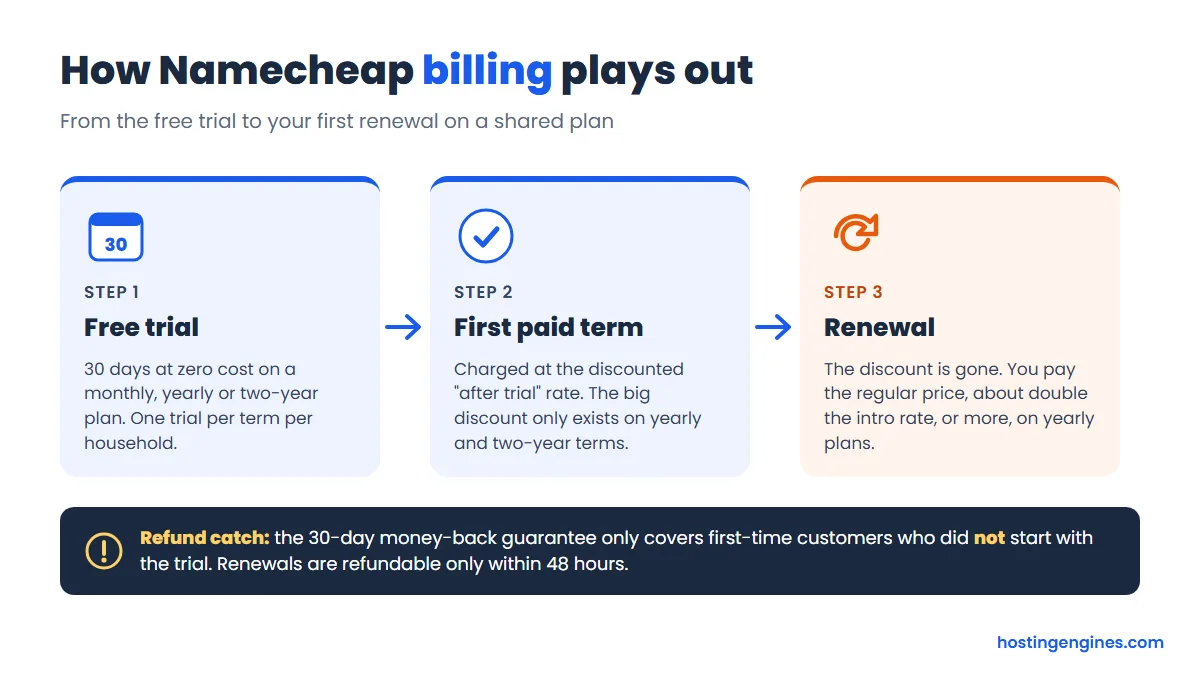
So which should you pick? If you only want to poke around cPanel and see if you like it, the trial is great. If you’re moving a real site and want a safety net after paying, skip the trial and buy the plan, so the money-back guarantee still applies. Also, when a yearly trial ends, your first payment is charged at the discounted after-trial price, and only later renewals move to the regular rate.
Free SSL: First Year Only
Every shared plan comes with up to 50 free Standard SSL certificates, one per domain or subdomain, issued and installed automatically. The catch is in the name of the offer: it’s a one-year free certificate.
After the first year you buy a renewal through the cart, and Namecheap installs it for you. A Standard SSL is currently listed at $5.99 for the first year and renews at $6.99 a year. Namecheap’s certificates now come from SSL.com, after a change of SSL provider. A few more conditions apply:
- The domain must point to Namecheap’s hosting nameservers.
- A domain that already used its free year can’t get another one, even in a new account or on a new plan of the same tier.
- Every certificate, including ones for test subdomains you later delete, counts toward the 50 limit.
Is it a deal breaker? For one site, an extra $7 a year is small. For ten client sites, it adds up, and many rivals include free, auto-renewing certificates for as long as you host with them. Weigh that against the low entry price.
Free Domain: What the Terms Say
Namecheap’s shared hosting terms say you can get a free domain for the first year, as long as it isn’t a “premium” domain, and only one domain per hosting plan. After that year, the domain renews at the normal registration price. The page doesn’t spell out which billing terms qualify, so check the cart before you pay if the free domain is part of your math.
Some domains also carry a $0.20 ICANN fee, and hosting buyers get discounts on .com, .net and several other extensions. If you already own your domain at Namecheap, connecting it to hosting takes a couple of clicks, which is one of the nicer parts of the whole setup.
Storage, Backups and AutoBackup
All plans run on SSD storage. Stellar Business on the US data center, and every plan on the EU and Singapore data centers, use Namecheap’s Cloud Storage, which spreads your data across several servers for extra protection.
Backups are where the plans really differ. Stellar gets server backups twice a week. Stellar Plus and Stellar Business add AutoBackup, which keeps 6 daily, 3 weekly and 5 monthly backups of your files, databases, email accounts and settings. You can restore from cPanel or download a copy. We’d still keep your own off-site backup, as you should with any host.
cPanel, WordPress and Website Builders
Namecheap uses standard cPanel, with two-factor login, and Softaculous for one-click installs of WordPress and 100+ other apps. If you’ve used cPanel anywhere else, you’ll feel at home. You also get SSH access (Jailshell), and support for PHP, Perl, Python, Node.js and Ruby.
For people who don’t want to touch WordPress settings, every plan includes the Sitejet AI Website Builder and an “AI for WordPress” tool that drafts pages from a prompt. They’re useful for a quick start, though you’ll still want to edit what they produce.
Data Centers: US, UK, EU and Singapore
You choose your data center when you buy. Namecheap offers the US, the UK, an EU location and Singapore. The EU and Singapore centers run on renewable energy, and Namecheap says some plans on the EU center include a free .eu domain for the first year.
Pick the one closest to most of your visitors. A US site serving US readers should stay in the US; a UK shop is better off in the UK center. Namecheap advertises a 100% uptime guarantee, and if it misses that, the remedy is account credit rather than cash.
Security
All shared plans include Imunify360, which covers malware scanning, a web application firewall and proactive PHP protection. KernelCare patches the server kernel without reboots, and accounts are isolated from each other. Namecheap’s Supersonic CDN, with DDoS protection, works only when your domain uses Namecheap’s hosting nameservers.
Email at your own domain comes with every shared plan: 30 mailboxes on Stellar and unlimited on the other two. You get webmail, forwarders, autoresponders and Jellyfish spam filtering. If you want a more polished inbox, Namecheap also sells Private Email separately, with a one-month free trial.
Customer Support
Namecheap offers support around the clock through live chat and email or tickets. Its knowledgebase says email replies should arrive within about two hours. There’s no phone line, and Namecheap says so plainly in its own help articles.
For most hosting issues, chat is the fastest route anyway. But if you know you’ll want to call someone when your site goes down, Namecheap isn’t for you. The knowledgebase is large and well organized, and it covers most cPanel tasks step by step.
Other Namecheap Products
- EasyWP: managed WordPress on Namecheap’s own cloud platform, without cPanel. Starter is listed from $3.24/month billed yearly.
- VPS hosting: from $3.88/month billed yearly for 1 CPU core, 1 GB RAM and 20 GB SSD, with a free domain for a year.
- Domains: still Namecheap’s strongest product, with WHOIS privacy included on eligible extensions.
- Reseller hosting, dedicated servers and paid SSL certificates round out the lineup.
Namecheap Alternatives
If something above put you off, here are the hosts we’d look at next:
- Hostinger: Premium is $2.99/month on a 48-month term and renews at $10.99, so the cheap rate lasts four years. No phone support either. Read our Hostinger review.
- Hosting.com (formerly A2 Hosting): Starter is $1.99/month on a 4-year term, with daily backups and phone support on every plan. See our Hosting.com review.
- Spaceship: another budget host that also lets you start free for 30 days, with a beginner-friendly dashboard on top of cPanel. Here’s our Spaceship review.
Namecheap Hosting Review: Final Verdict
Namecheap hosting does the basics well: cPanel, four data center regions, solid security tools and a free month to try it. For a small site, especially one whose domain already lives at Namecheap, it’s an easy and affordable choice.
Just go in with open eyes. The low price is for the first term, the free SSL ends after a year, and the trial cancels out the money-back guarantee. Our advice: take the two-year Stellar Plus plan if you want backups you can lean on, or use the trial to test things before you decide. Comparing more options? Our list of the best cheap web hosting puts Namecheap’s prices in context.
FAQ
Is Namecheap hosting good?
Yes, for small and simple sites. You get cPanel, unmetered bandwidth, Imunify360 security and a choice of four data center regions at a low starting price. It’s less suited to busy stores or anyone who needs phone support.
How much does Namecheap hosting cost after the first year?
Stellar renews at $55.88 a year, Stellar Plus at $85.44 and Stellar Business at $128.88 on yearly terms. That’s roughly double the intro price, because the advertised discount doesn’t apply to renewals.
Is Namecheap’s SSL really free?
Only for the first year. Shared plans include up to 50 free Standard SSL certificates for one year, then you buy renewals, currently from SSL.com, through the Namecheap cart.
Can I get a refund after the Namecheap free trial?
No. The 30-day money-back guarantee only applies to first-time shared hosting customers who didn’t start with the trial. If you want the refund option, buy the plan directly instead.
Does Namecheap have phone support?
No. Namecheap offers 24/7 live chat and email or ticket support, but no phone line.
Is Namecheap good for WordPress?
Yes. Shared plans install WordPress in one click through Softaculous, and Namecheap also has EasyWP, a separate managed WordPress platform, if you’d rather not deal with cPanel.