You want to host a website on Amazon Web Services, and every pricing page you open lists dozens of services with rates per hour, per gigabyte and per million requests. That is a hard way to answer a simple question: what will the bill be at the end of the month?
We read the current AWS price pages and price lists, then built three real monthly bills for a blog, a business site and an online store. This guide also covers the free tier, the hidden charges and the point where a normal web host is the saner choice.
Quick answer
AWS hosting costs about $9.50 a month for a small blog on Lightsail, around $33 for a business site with a database, and $70 or more for a busy store. Lightsail plans start at $5. Raw EC2 usually costs more for the same server, and traffic, IPv4 addresses and snapshots add extras.
Key takeaways
- Lightsail is the simple route: one fixed price per server, from $5 a month, with traffic included.
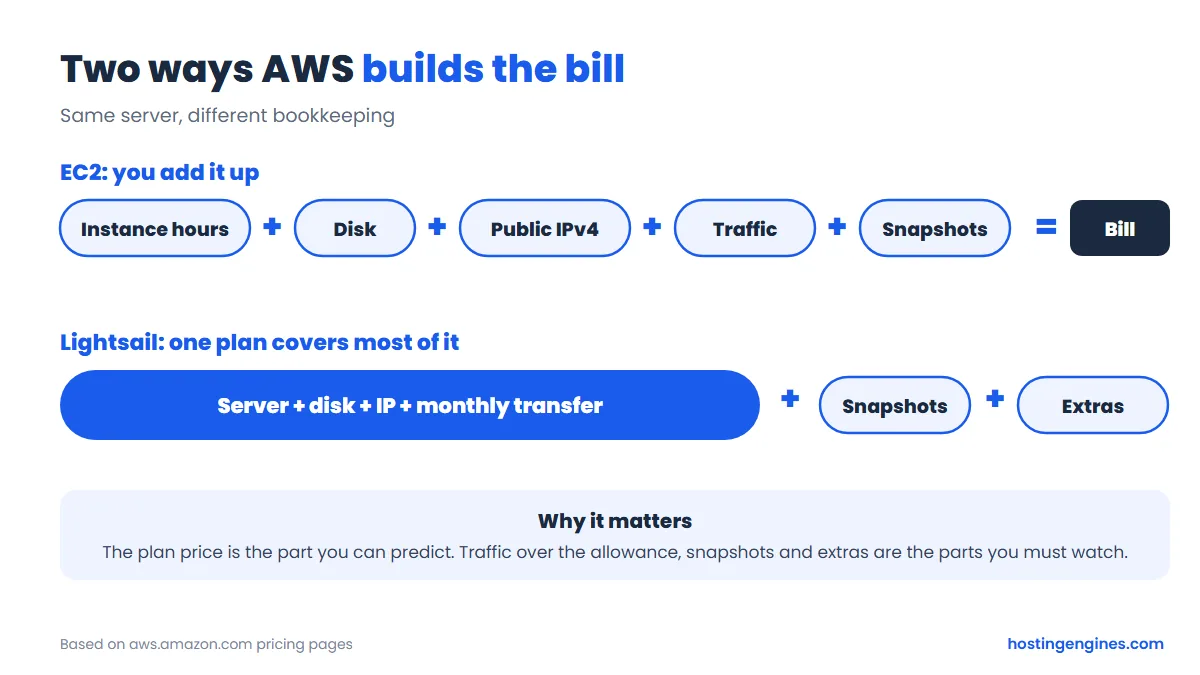
- EC2 bills the server, disk, IP address and traffic separately, so the same 1 GB server costs about $13 instead of $7.
- The new AWS f ree tier is $100 to $200 in credits for six months, not a free year.
- Outbound traffic at $0.09 per GB, public IPv4 addresses and forgotten snapshots are the usual bill surprises.
- For one ordinary site, a regular web host is often cheaper and needs less work.
| Setup | Monthly cost | Best for | Our verdict |
|---|---|---|---|
| Lightsail 1 GB blog | About $9.50 | A WordPress blog you manage yourself | Good, if you can run a server |
| Lightsail business site | About $33 | Site plus database and CDN | Fair, shared hosting is cheaper |
| Lightsail online store | About $71.50 | A store with steady traffic | Reasonable for a VPS build |
| EC2 and RDS store | About $83 | Teams that need AWS tools | Dearer, more to manage |
How much does AWS hosting cost?
AWS has no single hosting price. A small site on Lightsail costs $5 to $12 a month, and a site with its own database, CDN and backups lands between $30 and $75. If you build the same site from separate EC2, RDS and S3 parts, expect a similar or higher bill and more setup.
Every price below is in US dollars for the US East (N. Virginia) region, checked in 2026 on aws.amazon.com and in the price data those pages load. Other regions differ by a few percent, and Lightsail gives half the traffic allowance in some Asia and South America regions.
Which AWS services does a website really use?
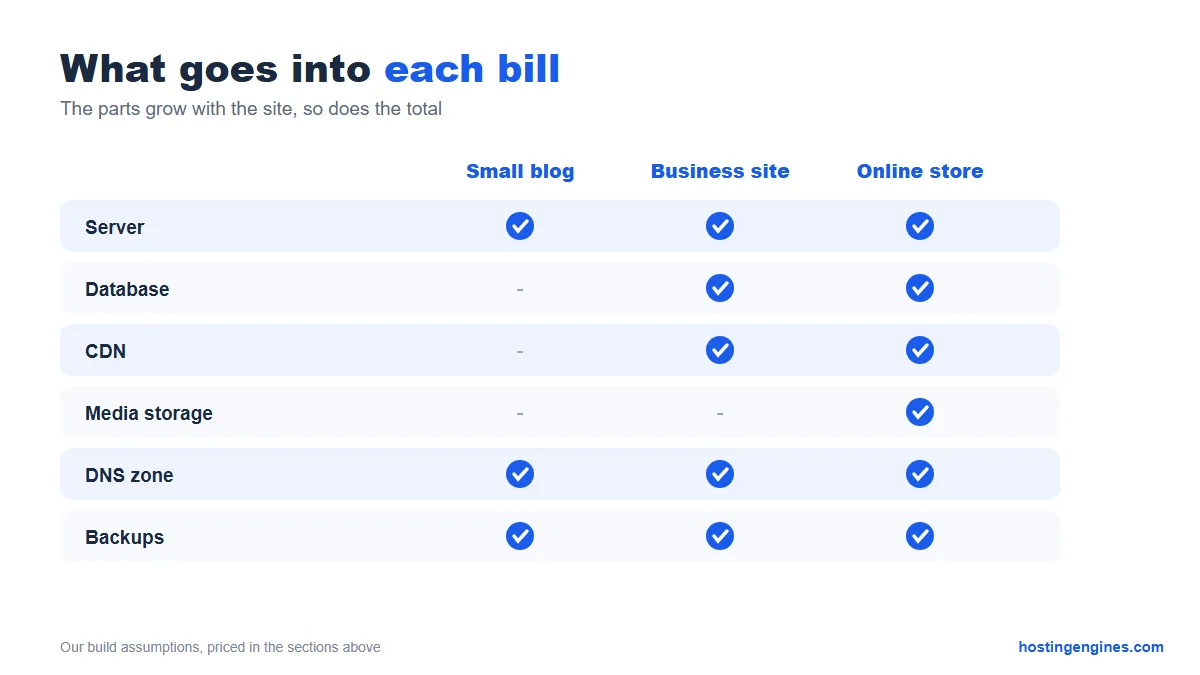
A normal website touches five to seven AWS services: a server (Lightsail or EC2), a database (RDS or the Lightsail database), storage (S3 or a Lightsail disk), a CDN (CloudFront), DNS (Route 53) and a public IP address. Each one is a separate line on the bill, except on Lightsail, where several are bundled.
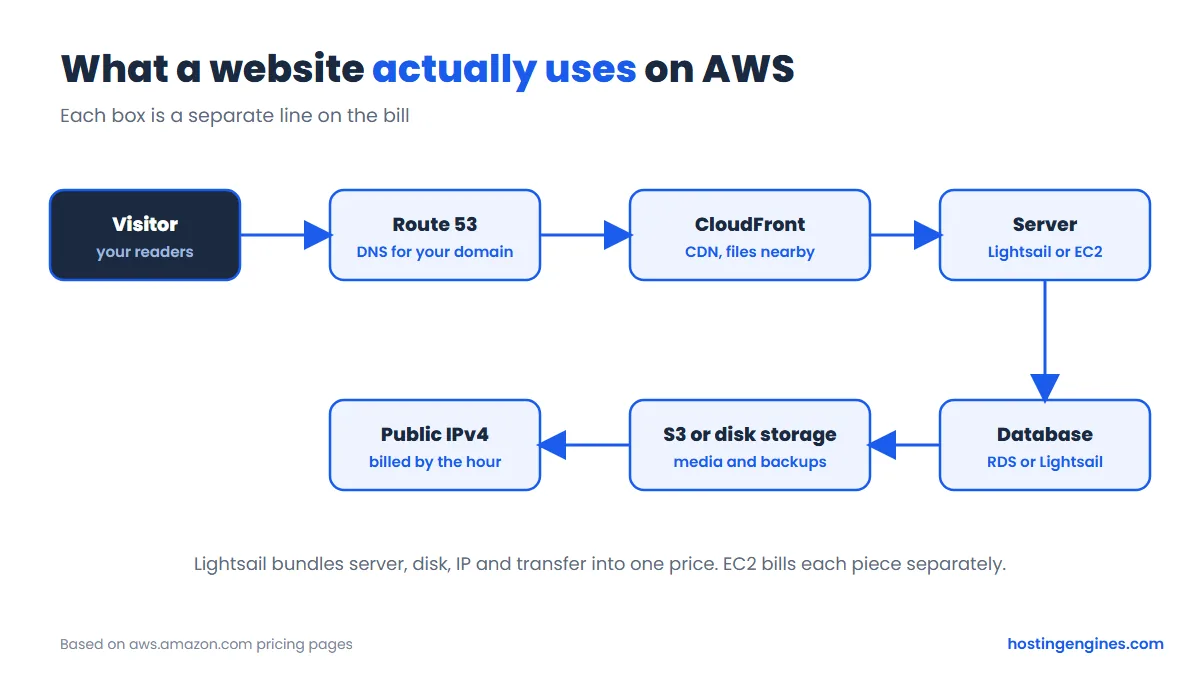
You do not need all of them. A blog can run on one Lightsail server with its own database inside it. A store usually adds a managed database and a CDN. A large company site spreads across all of them.
How much does Amazon Lightsail cost?
Lightsail costs $5 a month for 0.5 GB of RAM, $7 for 1 GB, $12 for 2 GB, $24 for 4 GB and $44 for 8 GB. Each plan includes an SSD disk, a static IP address and a monthly traffic allowance. Plans that skip the public IPv4 address cost $1.50 to $4 less.
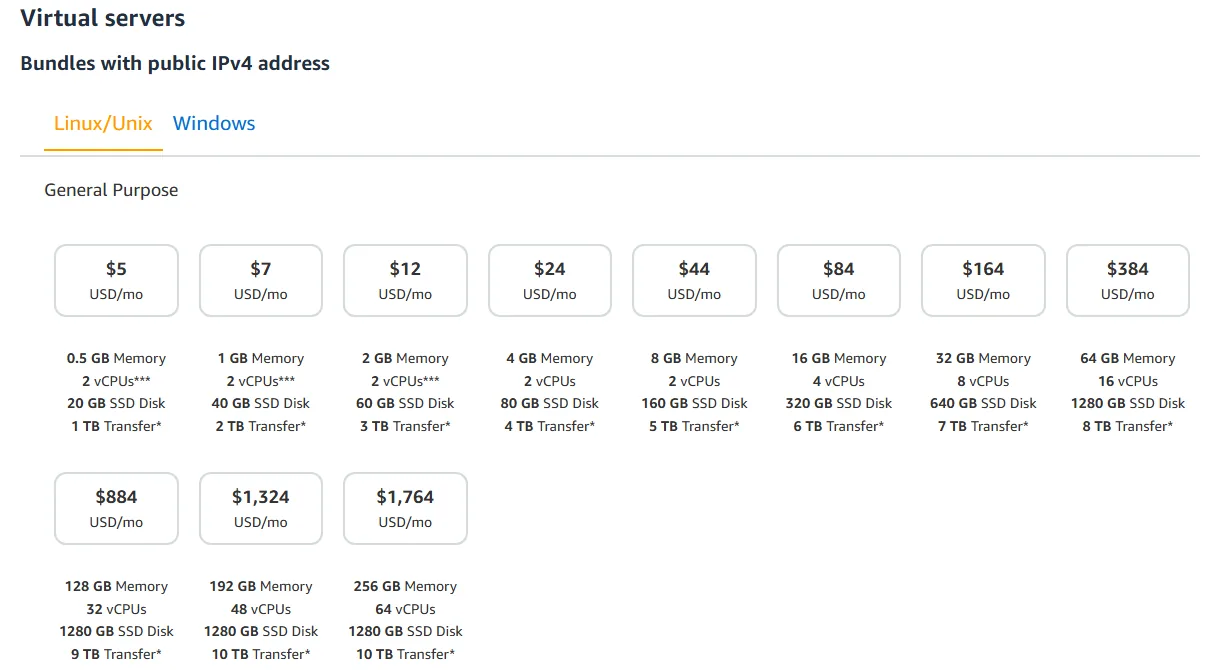
| Plan | RAM | vCPU | SSD | Transfer | Price with IPv4 | IPv6 only |
|---|---|---|---|---|---|---|
| 1 | 0.5 GB | 2 | 20 GB | 1 TB | $5 | $3.50 |
| 2 | 1 GB | 2 | 40 GB | 2 TB | $7 | $5 |
| 3 | 2 GB | 2 | 60 GB | 3 TB | $12 | $10 |
| 4 | 4 GB | 2 | 80 GB | 4 TB | $24 | $20 |
| 5 | 8 GB | 2 | 160 GB | 5 TB | $44 | $40 |
| 6 | 16 GB | 4 | 320 GB | 6 TB | $84 | $80 |
Lightsail also sells a managed database from $15 a month (1 GB RAM, 40 GB disk), object storage from $1 for 5 GB, a CDN from $2.50 a month for 50 GB and a load balancer at $18. Every price comes from the Lightsail pricing page.
Two details matter. Plans created before mid 2023 have one vCPU instead of two, and traffic counts inbound and outbound together. Go over the allowance and AWS bills outbound overage at $0.09 per GB.
How much does EC2 cost for a website?
A small EC2 server costs $6 to $30 a month for the instance alone: about $6.13 for a 1 GB t4g.micro and $24.53 for a 4 GB t4g.medium, billed at 730 hours a month. The disk, the public IPv4 address and traffic come on top, which is why EC2 usually ends up above Lightsail.
| Instance | RAM | Price per hour | Per month (730 h) |
|---|---|---|---|
| t4g.micro | 1 GiB | $0.0084 | $6.13 |
| t3.micro | 1 GiB | $0.0104 | $7.59 |
| t4g.small | 2 GiB | $0.0168 | $12.26 |
| t3.small | 2 GiB | $0.0208 | $15.18 |
| t4g.medium | 4 GiB | $0.0336 | $24.53 |
| t3.medium | 4 GiB | $0.0416 | $30.37 |
These are on-demand Linux prices in US East. The t4g line runs on AWS Graviton (Arm) chips and is cheaper, but some older software needs an x86 t3 instance instead.
Then add the extras. A gp3 disk costs $0.08 per GB a month, so 40 GB is $3.20. A public IPv4 address costs $0.005 an hour, about $3.65 a month. Put it together for a 1 GB server with 40 GB of disk and you pay $12.98 on t4g.micro against $7 for the Lightsail equivalent.
What do S3, CloudFront, RDS and Route 53 cost?
S3 storage costs $0.023 per GB a month, Route 53 charges $0.50 a month per domain zone, CloudFront starts free, and a small RDS MySQL database costs about $11.68 a month before storage. These are the add-ons most websites pick up, and each is priced separately.
| Service | What it does for a site | Price (US East) |
|---|---|---|
| S3 | Stores images, backups and downloads | $0.023 per GB a month; GET requests $0.0004 per 1,000 |
| CloudFront | CDN that serves files from nearby servers | Free plan, then $15 Pro; or pay as you go |
| RDS MySQL | Managed database | db.t4g.micro $0.016 per hour (about $11.68), db.t4g.small $0.032 (about $23.36), plus $0.115 per GB of storage |
| Route 53 | DNS for your domain | $0.50 per hosted zone a month, $0.40 per million queries |
| Public IPv4 | A fixed address for the server | $0.005 per hour (about $3.65 a month) |
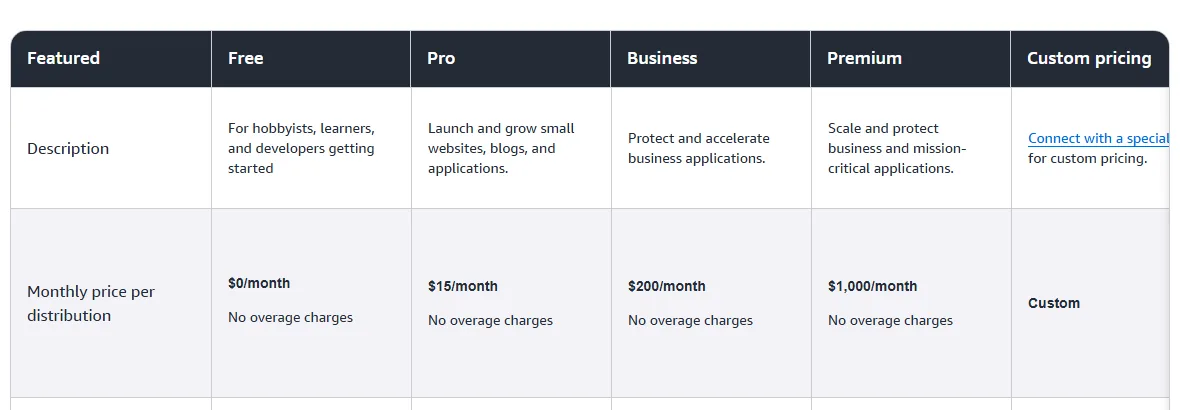
CloudFront now has flat-rate plans with no overage charges: Free at $0 (1 million requests and 100 GB), Pro at $15, Business at $200 and Premium at $1,000. If you prefer pay as you go, the first 1 TB of transfer and 10 million requests each month are free. Both are on the CloudFront pricing page.
RDS can double in price if you switch on Multi-AZ, which keeps a standby copy in a second zone. A db.t4g.micro goes from $0.016 to $0.032 an hour. Most small sites do not need it. Daily backups and a decent restore plan matter more.
Is AWS hosting free?
Only for a while. New AWS accounts get $100 in credits, with up to $100 more for trying services, for $200 in total. The free account closes after six months or when the credits run out, whichever comes first. After that you move to the paid plan and pay normal prices.
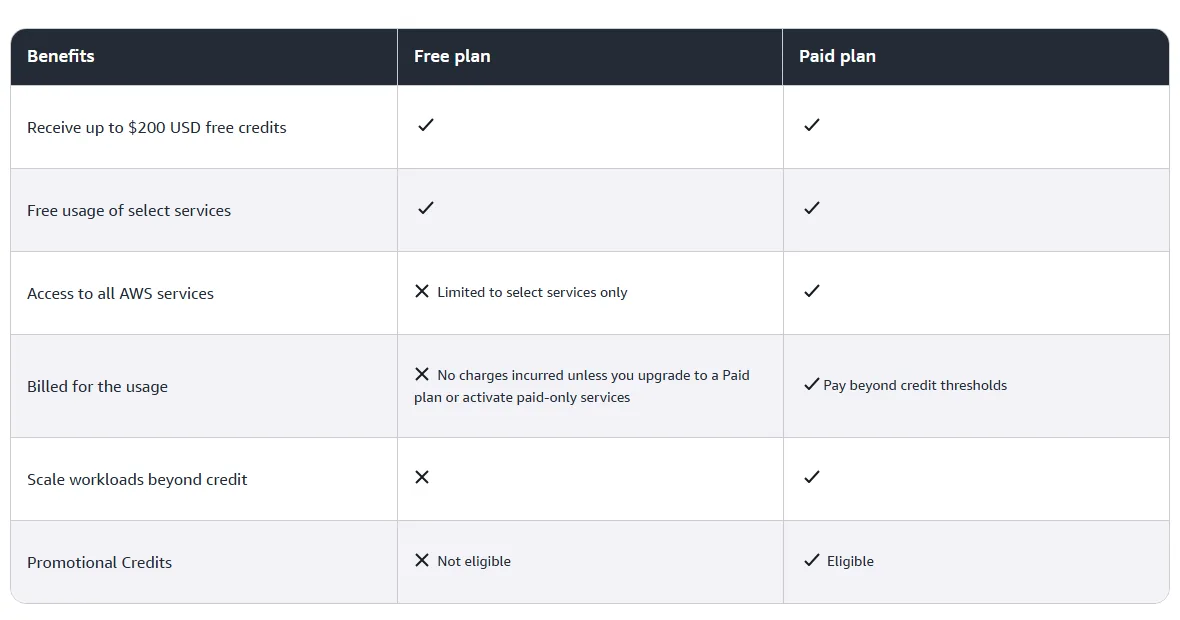
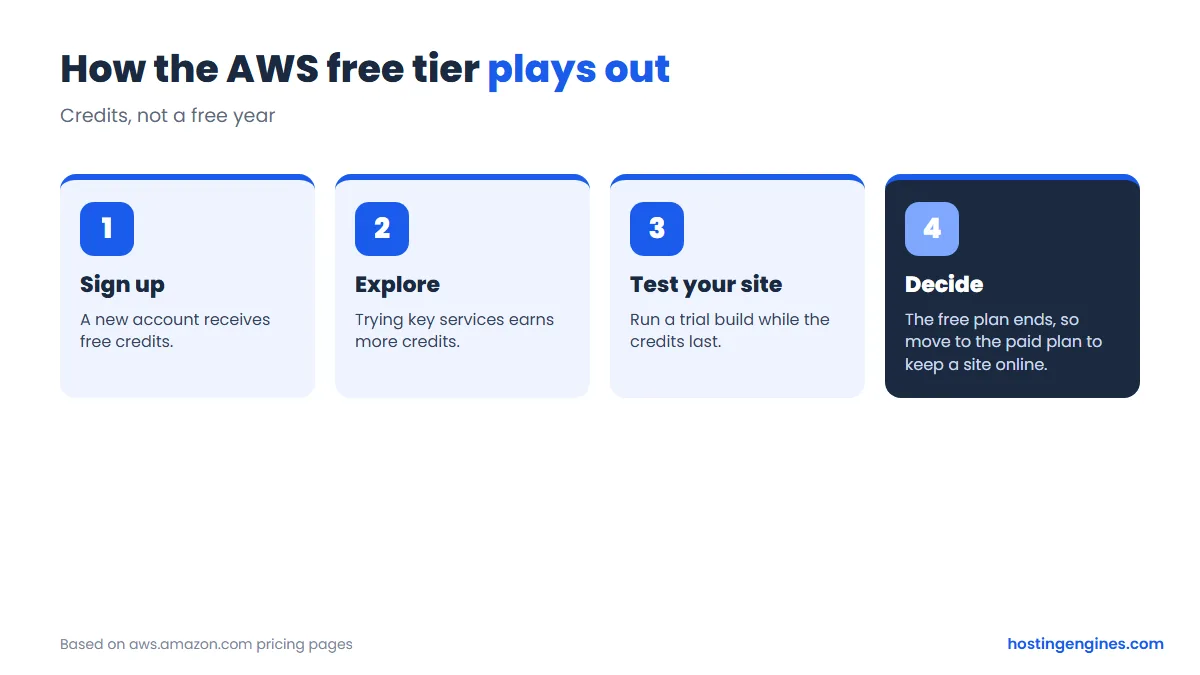
Older guides promise a free t2.micro or t3.micro for 12 months. That was the old free tier. The current AWS Free Tier page describes the credit model, and more than 30 services stay free inside monthly limits. The RDS page still mentions 750 free database hours for 12 months, so check which terms your own account shows before you plan around it.
Our advice: use the credits to test, then price your site on the paid plan from day one. If the monthly number in this post makes you wince, that is useful to know before you migrate anything.
How much will a blog, a business site or a store cost on AWS?
A small blog costs about $9.50 a month on Lightsail, a business site with a database and CDN costs about $33, and an online store costs about $71.50. These are real totals built from the plan prices above, before your domain name and any sales tax.
Small blog: about $9.50 a month
A WordPress blog with a few thousand visits a month fits the 1 GB Lightsail plan ($7), with the database on the same server. Add a Route 53 zone ($0.50) and weekly snapshots, which we counted at the full 40 GB disk size ($2.00). Total: $9.50.
Small business site: about $33 a month
A brochure site with a contact form, a booking plugin and customer data moves to a 2 GB server ($12) with the managed database ($15), a 50 GB CDN ($2.50), Route 53 ($0.50) and 60 GB of snapshots ($3.00). Total: $33.00. A shared host that includes email would cost less, but you would get less control.
Online store: about $71.50 a month
A WooCommerce store with a few hundred daily visitors needs a 4 GB server ($24), a 2 GB managed database ($30), a 200 GB CDN ($10), media storage ($3), Route 53 ($0.50) and 80 GB of snapshots ($4). Total: $71.50.
Build the same store from EC2 parts and it comes to about $83: a t4g.medium ($24.53), an 80 GB gp3 disk ($6.40), a public IPv4 address ($3.65), an RDS db.t4g.small ($23.36) with 20 GB of storage ($2.30), 300 GB of outbound traffic with the first 100 GB free ($18.00), Route 53 ($0.50) and snapshots ($4.00). Putting CloudFront in front can cut the traffic line: the EC2 pricing page lists data transfer from EC2 to CloudFront at $0.00 per GB, and CloudFront’s pay-as-you-go plan includes the first 1 TB free. You have to set that up and watch it, though.
What are the hidden costs of AWS?
The usual surprises are outbound traffic at $0.09 per GB, public IPv4 addresses at about $3.65 a month each, snapshots at $0.05 per GB that you forgot to delete, and extra CPU charges on burstable instances. None of them appears on a plan card, and all of them repeat every month.
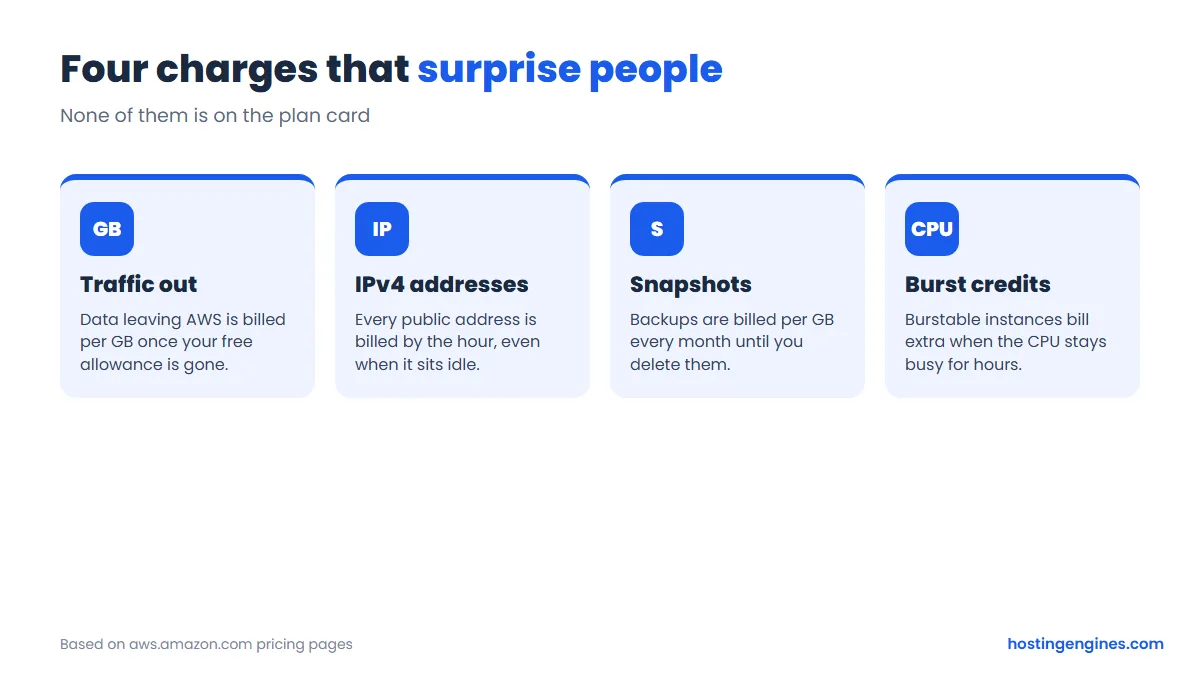
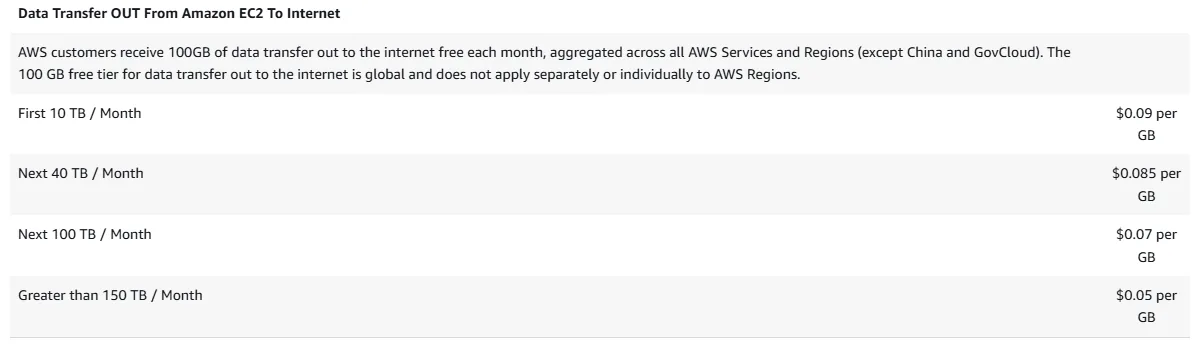
- Traffic. On EC2 you get the first 100 GB a month free across AWS, then pay $0.09 per GB. A video or a download page that goes viral hurts. Lightsail includes 1 to 5 TB, so it hides this risk on small plans.
- IPv4 addresses. AWS charges $0.005 an hour for every public IPv4 address, in use or idle. An old Elastic IP you forgot about costs $3.65 a month forever.
- Snapshots and backups. Lightsail and EBS snapshots cost $0.05 per GB a month. Keep 20 copies of a 60 GB disk and the backups cost more than the server.
- Burst CPU. T3 and T4g instances run in unlimited mode by default. Keep the CPU busy for hours and AWS bills $0.04 per vCPU hour on EC2, and $0.075 on RDS.
- Tax and support. Prices exclude tax, and paid support plans are extra.
We cover the same trap on ordinary hosts in our guide to the hidden costs of website hosting. AWS just has more of them.
Set a budget alert in the billing console on day one. It takes two minutes and is the cheapest insurance on AWS.
Is Lightsail cheaper than EC2?
Yes, for a small site. A 1 GB Lightsail server with a 40 GB disk, IP address and 2 TB of traffic costs $7 a month. The nearest EC2 setup costs $12.98 to $14.44 before any traffic. EC2 only wins when you need autoscaling, spot pricing, reserved discounts or services Lightsail cannot reach.
| Lightsail | EC2 | |
|---|---|---|
| Billing | One fixed price per plan | Instance, disk, IP and traffic billed separately |
| 1 GB server with 40 GB disk | $7 | $12.98 (t4g.micro) or $14.44 (t3.micro) |
| Traffic | 1 to 5 TB included on small plans | 100 GB free, then $0.09 per GB |
| Setup | Click-through console, one-click WordPress | More setup, more services to learn |
| Scaling | Move up a plan, limited autoscaling | Autoscaling groups, load balancers, spot pricing |
| Risk of a surprise bill | Low | Higher |
If you are comparing AWS with independent VPS providers, read our breakdown of DigitalOcean vs Vultr vs Linode, or our list of the best VPS hosting providers. Several of them quote one price for the same kind of server.
When is AWS the wrong choice for a website?
AWS is the wrong choice when you want a simple site with email and support included, or when you do not want to manage a server. On AWS you patch the operating system, secure the firewall and fix a broken WordPress update yourself. A regular host does that work for you.
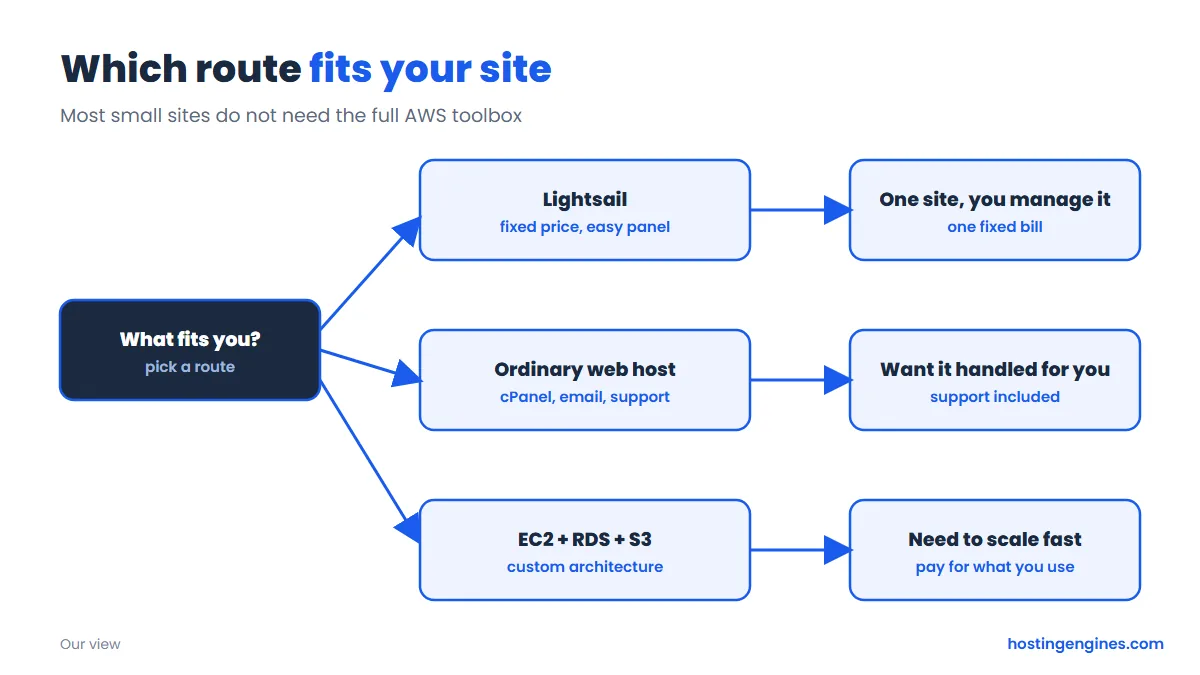
Think about what you are paying for. A shared hosting plan includes a control panel, email and support. Hostinger, for example, lists its Premium plan at $2.99 a month on a 48-month term, which renews at $10.99. Check the current terms before you buy, but the gap is large next to a $9.50 AWS blog bill.
AWS makes sense when you already work in the AWS ecosystem, need autoscaling for spiky traffic, store large media in S3, or want to run a developer-style stack. Our shared hosting vs VPS comparison explains where that line falls.
Our verdict
Lightsail is the only AWS route we would suggest for a small site. It is honest, predictable and cheap enough at $5 to $12 a month. Choose EC2 only for a reason you can name. And if you just want a blog online without running a server, a regular web host is the saner choice, and it costs less. See our guide to the real cost of web hosting for the comparison.
AWS pricing FAQ
How much does AWS cost per month for a small website?
A small WordPress site costs about $9.50 a month on Lightsail ($7 server, $0.50 DNS, $2 snapshots). On EC2 the same server costs around $13 before traffic. A static site on S3 and CloudFront can cost a few dollars, because both have free allowances.
Is the AWS free tier really free?
Yes, within limits. A new account gets $100 in credits plus up to $100 more, valid for six months. The Free plan will not bill you unless you upgrade. When it closes you must move to the paid plan to keep your site online.
Is Lightsail good for WordPress?
Yes. Lightsail offers WordPress images and a simple console. A 1 GB plan at $7 handles a small blog. You still manage updates, backups and security yourself, so it suits people who are comfortable with a server.
Why is my AWS bill higher than expected?
Look at outbound traffic ($0.09 per GB after the free 100 GB), public IPv4 addresses ($0.005 an hour each), old snapshots ($0.05 per GB), and burstable CPU charges. Use the Cost Explorer page in the billing console to find the biggest line.
Is AWS cheaper than regular web hosting?
Rarely, for one site. Regular shared hosting includes a control panel, email and support, and promotional plans cost a few dollars a month. AWS wins on flexibility and scale, not on the price of a small site.
How much does Route 53 cost?
A hosted zone costs $0.50 a month for your first 25 zones, and standard queries cost $0.40 per million. For one domain that is usually under a dollar a month. Domain registration is priced separately by extension.
Do I pay for CloudFront?
Not necessarily. The Free plan costs $0 and includes 1 million requests and 100 GB. Pay as you go also includes 1 TB of transfer and 10 million requests free each month. Heavy sites move up to the $15 Pro plan.
Final thoughts
For a small site, AWS means Lightsail at $5 to $12 a month, plus a few add-ons. Anything bigger is a build you should price line by line, with a budget alert on. If you want the same server without the AWS paperwork, compare the best VPS providers next, or check the Lightsail pricing page and start with the $7 plan.