Do you want to create your first website but don’t know which web hosting service will serve it well? In this article, you’ll learn exactly what to look for in a web hosting service.
Ideally, the answer to what to look for in a web hosting service depends on your needs, website needs, and your audience’s needs. Because there is a big difference between eCommerce sites and blog sites.
There are many factors to keep in mind when it comes to choosing a suitable web hosting service, I will show you each of them and my recommendations for the best web hosting provider at the end.
But before we dive into what to look for in a web hosting service, let’s get acquainted with some terms.
What is web hosting?
Web hosting is a service that provides space on a server for websites, web applications, and other services to be hosted. Websites need to be hosted in order for them to be accessible from the internet.
Web hosting is one of the most crucial aspects of running a website. Without web hosting, websites cannot be viewed.
What is a web host?
A web host is a company that provides the necessary software and hardware for websites to function on a network. Web hosts offer services such as website creation, website hosting, domain registration, and email hosting. They also provide other services such as caching and CDN services.
What to Look For in a Web Hosting Service?
Here are the most important things to look for when choosing a web hosting service.
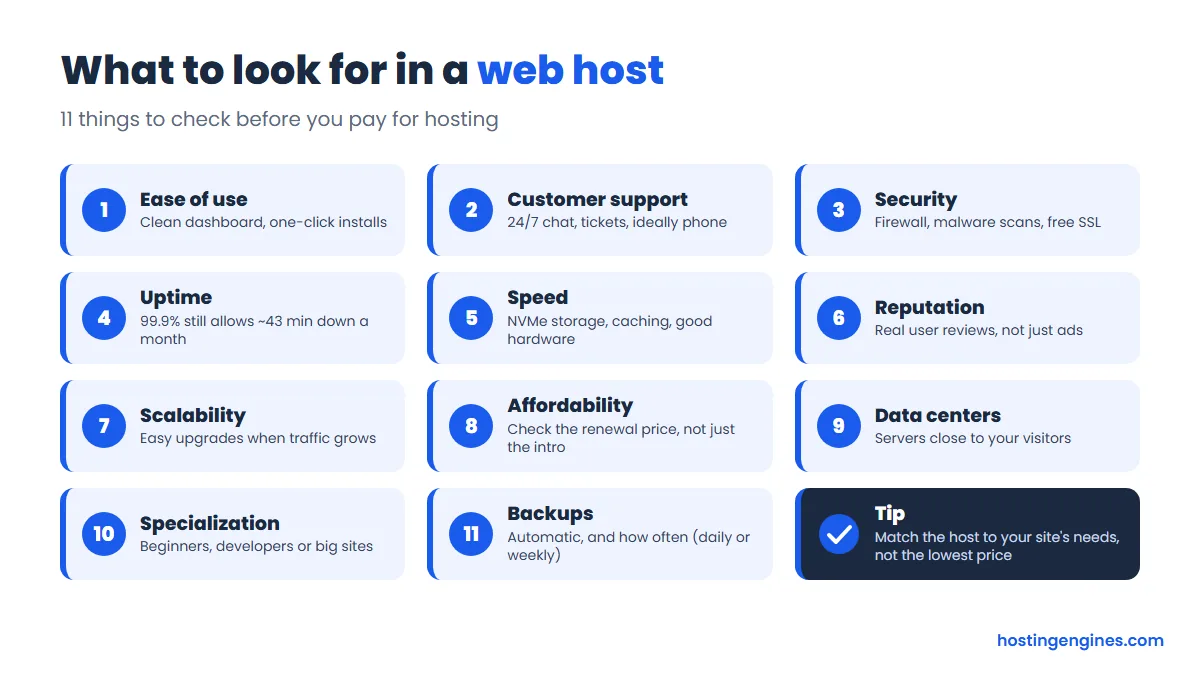
1. Ease of use “User-friendly”:
Especially for beginners, web hosting should be user-friendly because it will help the website owner to maintain their site without any hassle.
Web hosting providers should be able to provide user-friendly interfaces and management tools. The complexity of a web hosting interface can make it difficult for customers to find what they’re looking for.
Web hosting with a complex interface is not ideal, because, with too complex options, users might not know how to use it. This makes it difficult for users to navigate through the admin panel and find what they need.
Most web hosting companies have gone through the process of making their services easy to use and accessible, so it’s not difficult to find a web hosting provider with a great user interface.
2. Customer Support:
Web hosting Customer Support is one of the most important aspects to look for in a web hosting service to run a successful business website. It can be difficult for companies, especially beginners, to find the right solution for their needs.
Web hosting customer support is not just about providing assistance to customers in the form of solutions and troubleshooting, it is also about building a relationship with them.
So, providing support service is a crucial thing to be found in a hosting service, especially for new ones in the field.
When something goes wrong (for example, your website goes down), you’ll need to reach someone on the support team who can help you fix it fast.
This is important because every time your website is not online you will lose your audience and visitors.
Before you move forward with the hosting service try to sign up, and give the support line a call to see whether the customer service team is knowledgeable and helpful.
Make sure to check what support options a web host offers before purchasing anything. Many of them have 24/7 phone calls, live chat, and email support, while others only provide one or two channels to contact you.
Ideally, the host you sign up with offers all of these channels, and 24/7 live chat at the very least.
3. Security:
Web hosting security is one of the important factors to look for in a web hosting service. It is not just about the data stored in the servers, but also about the reputation of the company you build along with your website.
To build a reputation of trustworthiness, companies need to make sure that their servers are secure and that they have taken all the necessary steps to protect their customers’ data.
The web hosting industry has been experiencing an increase in cyber-attacks and hacking attempts over the past few years. This has led to companies taking more precautions towards their data storage and protection.
It is crucial that your website or blog is safe from hackers, and web hosting security has many layers. Some of them are listed below (we cover more in our guide to essential web hosting security features):
- Vulnerability Scanning: This type of web hosting security scans for vulnerabilities on your website and ensures that your website is safe from hackers.
- Firewall: The firewall provides protection against DDoS attacks, malware, and other cyberattacks.
- Malware Protection: This type of web hosting security protects your website from malicious software like viruses, spyware, and Trojans.
- Intrusion Detection System (IDS): IDS helps to detect attacks or suspicious activities on your website like fraud or unauthorized access attempts by hackers.
4. Reliability and Uptime Performance:
Web hosting reliability is an important factor to consider when you choose a web hosting service. A reliable web hosting service will have a great uptime guarantee, and the site should be able to withstand high traffic loads.
Uptime is the time that a website or web application has been available without any interruptions. It is a measure of how long the web hosting service has been available and accessible for its users.
Uptime is important for the digital world because it allows businesses to be online and provide services to their customers. Uptime also helps with search engine optimization (SEO).
With bad uptime, you can expect your website to be down and your businesses can suffer a lot of problems. You may lose clients or customers, lose traffic, and eventually lose revenue.
Bad uptime is caused by many different factors such as hardware failures and software malfunctions. These problems can cause downtime that affects business operations in a negative way.
Letting your website go offline even for a few minutes can hurt. If someone is looking for something on your site and it doesn’t open, they’ll get a bad impression and may never come back.
A 99.9% uptime guarantee still allows about 43 minutes of downtime in a month, which adds up to almost 9 hours a year. At 99.99%, that drops to about 4 minutes a month.
So, If you want to build an excellent website, it’s better to have a web hosting provider that offers a high server uptime, at least a 99.95% uptime guarantee if not 99.99%. This is because websites that can’t load are useless.
5. Speed Performance:
Web hosting speed is one of the most important factors that you should consider when looking for a web hosting service. It is a deciding factor in whether or not to choose a certain web host.
The speed at which a website loads is an important factor for both users and search engines. Slow load speeds can affect your SEO ranking, which will make it difficult for people to find your website and its content.
Also, It’s important that your website loads quickly so that the user experience is smooth and uninterrupted. A fast and responsive website is an essential part of your online presence.
Of course, optimizing your content and websites can enhance the webpage loading time, but the crucial part is the web hosting itself. Our free page weight checker shows which files slow a page down.
Web hosts play a major role in speeding up your website loading time or making it slow. So, always check the web hosting service speed before you sign up for it.
6. The Reputation of the Hosting Service:
Some popular hosting services can have a poor reputation and perception. And other not many people know about it, yet, it’s considered to be one of the best.
Take Bluehost. It’s one of the best-known hosts, partly because it pays generous affiliate commissions, so lots of bloggers promote it. In our experience, though, it isn’t faster than Hostinger, and its entry plan costs more.
The cause of this poor reputation can be generally due to the problems of the previous buyers. This can affect the stability of your website, so this is an important factor to be considered when choosing the web host service.
Checking online forums like Quora and others can be made before choosing a hosting plan. This is to look for security, reliability, and consistency. This step will not take much time, but it has a huge effect.
7. Scalability:
Scalability is the ability of a system to handle increased demand. It is important for any business to have this feature in order to grow. This helps in optimizing resources and maintaining uptime.
Scalability is one of the most important aspects of web hosting. It is an important factor that determines how well a website can handle traffic, optimize resources, and maintain uptime.
Web hosting scalability is important also because it allows for the growth and success of your business. It also helps with the cost efficiency and performance of your website as well as with the SEO ranking on search engines.
A scalable web host can be used for different types of websites such as e-commerce websites, blogs, or even personal websites. You don’t want your eCommerce website to crash on Black Friday.
On your website, you will need to ensure that your server will not fall apart if it receives many requests. You have to make sure that it will handle any number of traffic.
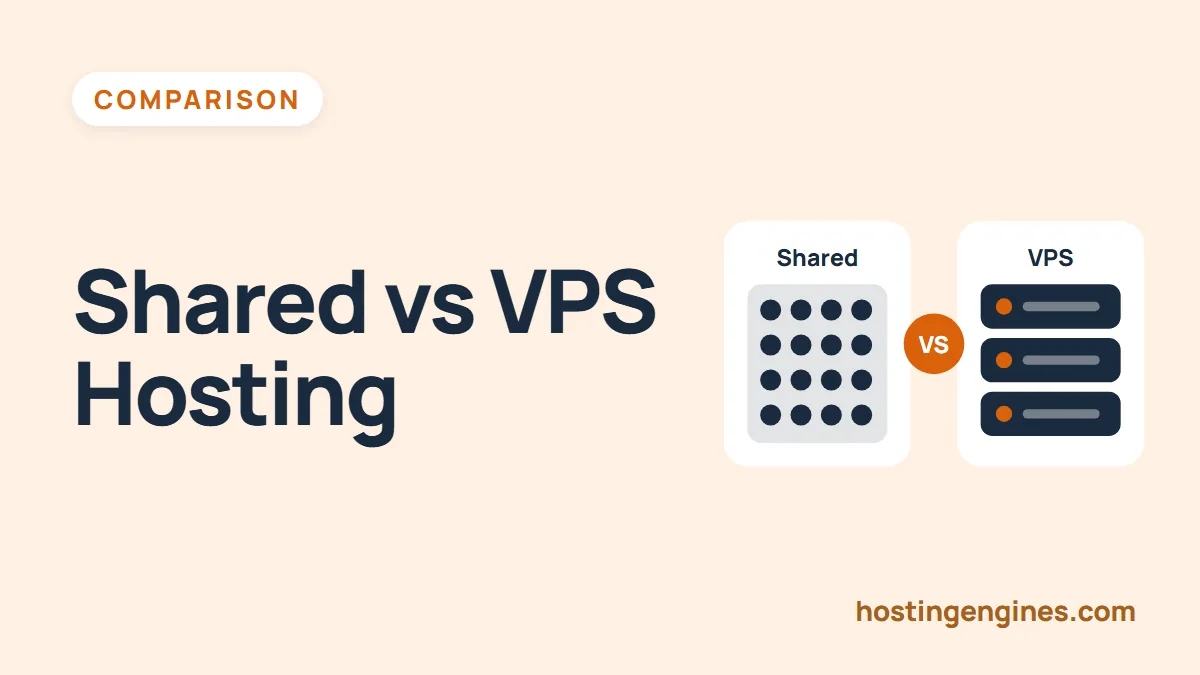
Web hosting systems are designed with different capacities to meet different needs. For example, shared hosting systems have lower capacity than virtual private servers (VPS) or dedicated servers with high capacity.
So make sure to sign up for a web host that can handle your sudden traffic and you can always upgrade to bigger plans if needs to.
8. Affordability:
The cost of the hosting plan is an essential thing to look for when it comes to choosing a web hosting provider. You may be on a budget and can’t afford much money but want the best hosting provider for your money.
There are lots of web hosting providers that offer various plans and pricing for their services. Therefore, choosing the price depends on your needs.
Choosing the suitable plans depends on many things such as:
- Your Budget: If your budget is low, you may have to start with a low-price basic plan such as shared hosting. If your budget is higher, then you should look into bigger plans from managed VPS or cloud hosting plans.
- Your website needs: If your website is a brand new blog, you can start small, and when you scale up you can easily scale up your plan as well.
- Type of web hosting: There are Shared Hosting which is basically the cheapest hosting type, VPS costs more but offers more features and powerful plans, and the dedicated server is the most powerful web hosting type but comes at a high price, it meant for really big sites.
- The hosting provider: Some shared hosting providers offer a shared hosting plan for $5 per month, and others offer the same plan, sometimes with more features, for $2 per month.
Do your search very well. If you are on a budget, think of small hosting plans, with shared plans, and if you feel like you are going to make huge traffic choose better plans.
9. Server Location “Data centers”:
Data centers are typically large buildings that contain a number of cabinets filled with servers, networking equipment, and other computer hardware. They can be on or off-premises and can be either owned or leased by an organization.
Data centers are the backbone of the internet, it is where all the data for websites and applications are stored. Data centers also provide a lot of other services such as cloud computing.
Server Location is one of the most important factors to consider when it comes to website performance. This is because the server location can affect the time it takes for a website to load and also, the amount of data that is transferred.
It affects website performance because of latency. Latency is the time it takes for a message to travel from one point to another. You should find a server that is closest to your targeted customers, when your server is close to the visitors and audience, your pages will load to them in a fast way.
So check how many data centers a web host has and where they are before you sign up. Our guide on how to choose the best server location walks you through it.
10. Areas of Specialization:
Some web hosts specialize in providing web hosting services for big sites, others are more for developers and freelancers, and others are more beginner-friendly.
Determine what your financial and knowledge capabilities are to determine what is the most suitable web hosting for you.
11. Backups:
Backup is the process of making a copy of the data on a computer or server. It can be done manually, using software, or by using an external device.
Black-hat hackers are a constant threat to website owners. Some of them try to damage or wipe a site’s files and database.
That’s why a recent backup is your best safety net. Make sure your host has a solid backup setup, because rebuilding a website’s content from scratch is frustrating and sometimes impossible.
Regular automated backups are best, so pick a host that includes them (and check whether they’re daily or only weekly). They don’t just help after a hack, they also save you when you delete something by mistake.
Recommendations: Our top picks for the best web hosting service
For small and brand new websites we recommend Shared Hosting plans, and we recommend Hostinger web host, which starts at $2.99 a month (Premium plan on a 48-month term, renewing at $10.99).
For websites and blogs that have decent traffic, we recommend managed cloud hosting on your own server, and our pick is Cloudways, with managed servers starting at $11 a month.
For eCommerce and big business sites that have loads of traffic, we recommend dedicated or bare metal servers, and we recommend Vultr.
For web developers, we recommend unmanaged VPS servers on Vultr, where a regular 1 GB cloud server costs $5 a month.
The Conclusion
There are many factors to weigh when choosing a hosting service. Some people treat them as major decisions, while others barely think about them.
Anyway, when you want to choose the hosting service, make sure that it matches your website and your needs.
Read also:
How To Check Web Hosting Expiry Date?
Pros and Cons of Free Web Hosting.
How Does Web Hosting Affect Website Performance?
Hidden Costs of Website Hosting.